Written by: Ryan Gardner, Owner, Managing Partner, CEO, Bucked Up
Key Takeaways
-
Proprietary blends hide actual L-Citrulline doses, so athletes cannot easily see the ingredient amounts that matter for performance.
-
L-Citrulline bypasses first-pass metabolism and raises plasma arginine levels more effectively than direct L-Arginine, which supports nitric oxide production and blood flow.1
-
Transparent labels disclose either pure L-Citrulline or Citrulline Malate 2:1 outside any blend, with 6 g Citrulline Malate 2:1 delivering roughly 4 g of actual L-Citrulline.
-
Studied doses range from 3–8 g depending on training goal, and consistent daily use often outperforms single pre-workout doses for exercise tolerance and recovery.1
-
Bucked Up delivers fully disclosed L-Citrulline doses across its pre-workout lineup and offers a standalone L-Citrulline powder so you can dial in your exact protocol and train with confidence.
How Athletes Use L-Citrulline
L-Citrulline is studied across two primary training contexts: resistance exercise and endurance exercise. In resistance training, acute supplementation with 8 g Citrulline Malate taken one to two hours before exercise has been reported to support recovery from delayed muscle soreness at 24 hours post-exercise (effect size 0.99) in some resistance training contexts1, based on a 2019 review by Trexler et al. in the Journal of Strength and Conditioning Research. In endurance contexts, a 2015 randomized controlled trial (n=10) by Bailey et al. found that L-Citrulline supplementation supported blood pressure and oxygen uptake kinetics during high-intensity exercise, whereas L-Arginine did not produce these effects.*
The practical takeaway: L-Citrulline is not a one-trick pump ingredient. It supports nutrient delivery, ammonia clearance, and exercise tolerance across training modalities, effects that stem from how the body processes citrulline differently than direct arginine supplementation.1
How L-Citrulline Works in the Body
The pharmacokinetics of L-Citrulline separate it from direct L-Arginine supplementation. L-Citrulline bypasses intestinal and liver first-pass extraction almost entirely, whereas L-Arginine undergoes heavy metabolism by arginase in the gut and liver before reaching systemic circulation. Once absorbed, L-Citrulline travels to the kidneys, where argininosuccinate synthase and argininosuccinate lyase convert it into L-Arginine, which is then released directly into circulation. This process produces a more sustained elevation of plasma L-Arginine than direct L-Arginine supplementation provides.*
That circulating L-Arginine supplies Nitric Oxide Synthase enzymes with the substrate needed to produce nitric oxide, a gaseous signaling molecule that supports the relaxation of vascular smooth muscle and vasodilation.*1
L-Citrulline also functions as a key intermediate in the urea cycle, the process that converts ammonia, a byproduct of protein metabolism and intense exercise, into urea for excretion. Supporting ammonia clearance may help reduce exercise-induced ammonia accumulation in skeletal muscle, which is associated with central fatigue.*1 Peak plasma concentrations of L-Citrulline typically occur within 0.7 to 2 hours post-ingestion, which informs the 30 to 60 minute pre-exercise timing window covered later in this article. That timing matters, but so does the form you choose, because different forms deliver different amounts of active citrulline per gram.
Forms of L-Citrulline and What Labels Really Mean
Two forms dominate the pre-workout market: pure L-Citrulline and Citrulline Malate, typically in a 2:1 ratio of L-Citrulline to Malic Acid. Knowing the difference is the first label-reading skill worth developing.
Pure L-Citrulline delivers 100% of its listed weight as L-Citrulline. Citrulline Malate 2:1 does not. In a 2:1 Citrulline Malate product, only about two-thirds of the listed weight is actual L-Citrulline; a label claiming 6 g of Citrulline Malate delivers roughly 4 g of L-Citrulline. That distinction matters when you compare labels across products.
The Malic Acid component of Citrulline Malate is a Krebs Cycle intermediate theorized to support oxidative ATP production and phosphocreatine recovery, which may support endurance and reduce fatigue.*1 However, a systematic review by Gough et al. (European Journal of Applied Physiology, 2021) concluded that the addition of malate to citrulline has not been demonstrated to enhance exercise performance outcomes over citrulline alone. The malate component may still contribute to energy metabolism support, but the research picture is not settled.
When evaluating a label, start by identifying the form, either pure L-Citrulline or Citrulline Malate with its ratio specified, because that determines how much active ingredient you get per gram. Next, verify that the gram amount appears outside any proprietary blend, since blends hide whether you are hitting studied dose thresholds. Finally, check for absorption support ingredients such as Astragin®, which can influence how much of the disclosed dose reaches your bloodstream. Those three criteria separate transparent formulas from the rest.
Bucked Up promotes a science-backed approach to L-Citrulline dosing, with both Citrulline Malate and Pure L-Citrulline options available. Compare the full lineup to find which form and dose matches your training protocol.
How Bucked Up Formulas Use L-Citrulline
Transparent dosing functions as a label criterion rather than a slogan. Here is how that looks in practice across the Bucked Up pre-workout line.
Bucked Up Pre-Workout and Woke AF both disclose 6,000 mg of Citrulline Malate 2:1 per serving, placing the L-Citrulline component at approximately 4 g and the Malic Acid component at approximately 2 g. That 6,000 mg figure aligns with the dose range studied in resistance training contexts.1 Woke AF pairs that same Citrulline Malate dose with 333 mg of caffeine.*
Mother Bucker takes a different approach. It lists 4,000 mg of pure L-Citrulline, with no Malic Acid, alongside Nitrosigine® and Hydroprime® Glycerol, forming what Bucked Up calls the Pump Trifecta. This combination supports vasodilation through nitric oxide pathways and cellular hydration through glycerol.*1 Every formula in the line includes Astragin®, which is studied to support citrulline absorption and bioavailability.*1
The Non-Stimulant Pre-Workout also carries 6,000 mg Citrulline Malate 2:1, which makes it a viable option for evening training or for athletes managing caffeine intake.*
Typical L-Citrulline Dosing and Timing
Timing and dose are the two variables that most affect whether L-Citrulline does anything useful in a pre-workout context. For acute performance support, L-Citrulline is typically taken approximately 60 minutes before intense physical activity, which aligns with the 0.7 to 2 hour window for peak plasma concentrations. A 30 to 60 minute window works as a practical range for most training schedules.
For daily supplementation outside of pre-workout use, studied doses for cardiovascular function support in healthy adults range from 3 g to 6 g of pure L-Citrulline per day.* Multi-day supplementation with pure L-Citrulline at 6 g per day for 7 or more days has shown some benefit for exercise tolerance in small studies of recreationally active adults, whereas single pre-exercise doses have consistently failed to support performance in well-controlled trials of resistance exercise. These findings suggest daily consistency may matter as much as acute timing.
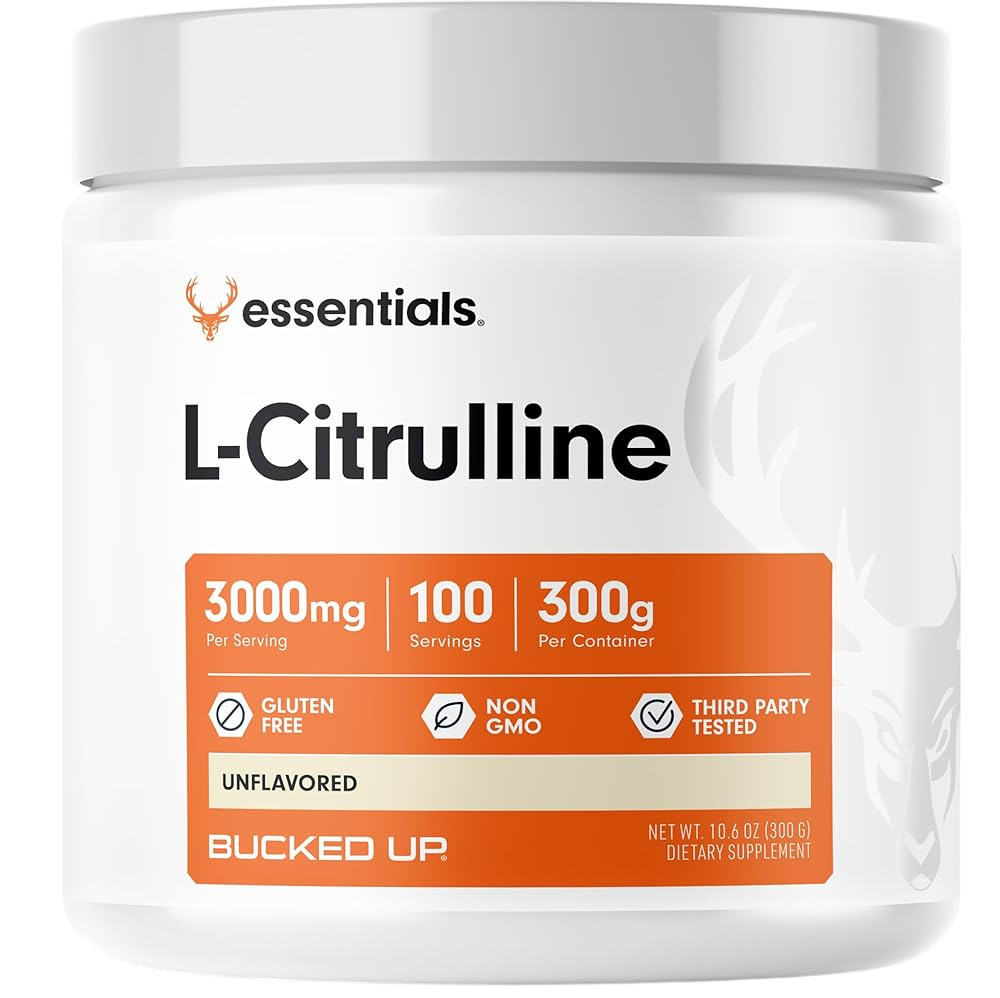
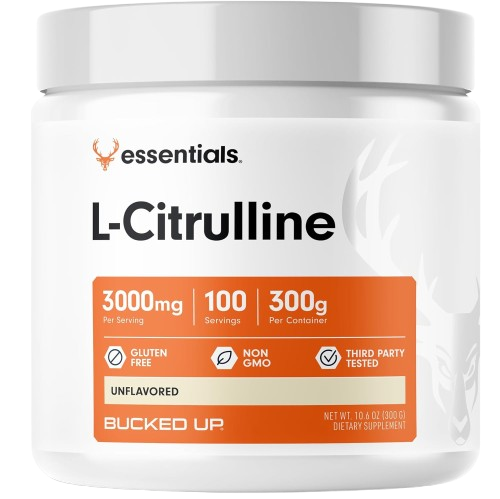
Bucked Up’s L-Citrulline Powder (300 g) provides 3,000 mg per scoop of pure L-Citrulline, unflavored, which makes it easy to stack with any pre-workout or beverage for athletes running higher-dose daily protocols.
Benefits and Realistic Expectations
L-Citrulline supplementation is studied for the following structure/function applications in healthy adults:*
Supports nitric oxide production.* Supports muscle pump during resistance training.* Supports ammonia clearance and may help reduce exercise-induced fatigue accumulation.* Supports recovery from intense training, with some data on delayed muscle soreness reduction.* Supports cardiovascular function and healthy blood pressure already in the normal range.* Supports cognitive function via cerebral blood flow support.*1
Practical limits exist. A 2024 study (Martin-Olmedo et al., International Journal of Sport Nutrition and Exercise Metabolism) in 43 healthy, resistance-trained men and women found that 5.3 g citrulline plus 2.7 g malate taken 45 minutes before low-to-moderate-volume resistance training did not support muscle strength or endurance compared to the same 5.3 g dose of pure L-Citrulline, and neither form outperformed placebo. The 2021 Gough et al. review similarly identified methodological inconsistencies across the citrulline malate literature. These findings do not invalidate the ingredient. They show that dose, form, training volume, and supplementation duration all interact.
*These statements have not been evaluated by the Food and Drug Administration. This product is not intended to diagnose, treat, cure, or prevent any disease.
Which Athletes Might Benefit Most
Three athlete profiles map well to the Bucked Up L-Citrulline lineup.
The Pump Chaser trains hard but feels flat, with inconsistent vascularity that signals inadequate nitric oxide support. The Citrulline Malate dose in Bucked Up Pre-Workout sits at the threshold studied for supporting nitric oxide and blood flow, which directly supports the pump and nutrient delivery to working muscle.*1 This formula suits athletes who want disclosed doses and a pre-workout that does not hide behind a proprietary blend.
The High-Tolerance Veteran has built a caffeine tolerance that requires higher stimulant loads, yet high-stim pre-workouts can support vasoconstriction without enough citrulline to counterbalance. Woke AF carries 333 mg of caffeine alongside the same 6,000 mg Citrulline Malate 2:1 dose, which supports vasodilation alongside the stimulant load.*1
The Science-Based Bodybuilder understands the pharmacokinetics and wants the advanced stack. Mother Bucker pairs 4,000 mg of pure L-Citrulline with Nitrosigine® and Hydroprime® Glycerol, supporting nitric oxide pathways and cellular hydration through multiple mechanisms.*1
Each formula in the Bucked Up line discloses its citrulline content and form. See which formula matches your athlete profile and training goals.
Safety, Interactions, and Product Quality
L-Citrulline is generally well-tolerated at doses studied for performance support. Mild and infrequent side effects include gastrointestinal discomfort such as nausea, bloating, or cramps, particularly at single doses of 10 g or more, and headaches in individuals sensitive to vasodilatory effects. Always consult your healthcare provider before adding L-Citrulline to your supplement routine, particularly if you take prescription medications.
Drug interaction categories to discuss with your healthcare provider include blood pressure medications such as ACE inhibitors and beta-blockers, nitrate medications such as nitroglycerin, phosphodiesterase-5 inhibitors, and anticoagulant or antiplatelet drugs. L-Citrulline’s vasodilatory effects may compound with these medications. Individuals with kidney conditions, naturally low blood pressure, or those scheduled for surgery should consult a healthcare provider before use. Use during pregnancy or breastfeeding should also be discussed with a healthcare provider.
Bucked Up products are manufactured in the USA in GMP, or Good Manufacturing Practices, certified facilities.
How to Compare L-Citrulline Pre-Workouts
Three label criteria provide an objective framework when you compare any performance lab style pre workout with L-Citrulline benefits.
First, check dose disclosure. The gram amount of L-Citrulline or Citrulline Malate should appear outside any proprietary blend. If the label lists a blend total without individual ingredient amounts, the actual citrulline dose remains unknown. Second, confirm form specification. The label should state whether the ingredient is pure L-Citrulline or Citrulline Malate, and if Citrulline Malate, the ratio, with 2:1 as the standard. Without the ratio, you cannot calculate the actual L-Citrulline content per serving. Third, look for absorption support. Ingredients studied to support citrulline bioavailability, such as Astragin®, indicate a formulator who considered whether the disclosed dose actually reaches circulation.*
Applying these three criteria to any label takes under 60 seconds and separates transparent formulas from those relying on marketing language over disclosed grams. See the FAQ below for specific questions on timing, stacking, and form selection.
Frequently Asked Questions
Can L-Citrulline be taken every day?
Yes. Daily supplementation with L-Citrulline is studied for cardiovascular function support and exercise tolerance in healthy adults. Studied daily doses for general support range from 3 g to 6 g of pure L-Citrulline. Some research suggests that consistent multi-day supplementation may produce more reliable effects on exercise tolerance than single acute doses alone. Always consult your healthcare provider before beginning any daily supplementation protocol.
When is the best time to take L-Citrulline before a workout?
For pre-exercise use, 30 to 60 minutes before training is the practical window, with 60 minutes being the timing most aligned with peak plasma concentration data. If you use a pre-workout formula that includes L-Citrulline alongside caffeine and other ingredients, follow the product’s serving directions, as formulation timing may differ from standalone L-Citrulline powder.
What is the difference between pure L-Citrulline and Citrulline Malate 2:1?
Pure L-Citrulline delivers 100% of its listed weight as L-Citrulline. Citrulline Malate 2:1 is a compound of L-Citrulline and Malic Acid in a two-to-one ratio, meaning approximately two-thirds of the listed weight is L-Citrulline and one-third is Malic Acid. A label listing 6 g of Citrulline Malate 2:1 delivers approximately 4 g of L-Citrulline. The Malic Acid component is a Krebs Cycle intermediate theorized to support energy metabolism, though current research has not definitively established that it enhances exercise performance beyond citrulline alone.
Can L-Citrulline be stacked with other nitric oxide ingredients?
L-Citrulline is commonly stacked with other ingredients that support blood flow and the nitric oxide pathway. Nitrosigine® is one example studied for blood flow support. Hydroprime® Glycerol is studied for cellular hydration support. Astragin® is studied to support citrulline absorption. When stacking, the total dose of each ingredient and any potential interactions with medications should be reviewed with a healthcare provider.
When should someone consult a healthcare provider before using L-Citrulline?
Consult a healthcare provider before use if you take prescription medications, particularly blood pressure medications, nitrates, or blood thinners, have kidney conditions, have naturally low blood pressure, are pregnant or breastfeeding, or have a scheduled surgical procedure within two weeks. L-Citrulline’s vasodilatory effects can interact with several medication classes, and individual health context matters.
Summary and Next Steps
A performance lab style pre workout with L-Citrulline benefits delivers on its promise only when the dose is disclosed, the form is specified, and absorption is considered. The science on L-Citrulline spans nitric oxide support, ammonia clearance, Krebs Cycle energy metabolism, and exercise recovery, with studied doses ranging from 3 g to 8 g depending on form and training context. The research also has limits, because single acute doses do not always outperform placebo in well-controlled resistance training trials, and the malate component of Citrulline Malate has not been definitively shown to add performance benefit over citrulline alone.
Current research supports dose transparency, form disclosure, and consistent daily intake as the variables most within an athlete’s control. The Bucked Up lineup applies these transparency principles across every formula, discloses every gram of Citrulline Malate 2:1 and pure L-Citrulline on the label, and offers standalone L-Citrulline powder for athletes who want to dial in their own stacking protocols.*
Bucked Up promotes a science-backed approach to L-Citrulline dosing, including Citrulline Malate and Pure L-Citrulline options. Start with transparent dosing and dial in your protocol.
*These statements have not been evaluated by the Food and Drug Administration. This product is not intended to diagnose, treat, cure, or prevent any disease.
References
Gough, L. A., Sparks, S. A., McNaughton, L. R., Higgins, M. F., Newbury, J. W., Trexler, E., Faghy, M. A., & Bridge, C. A. (2021). A critical review of citrulline malate supplementation and exercise performance. European Journal of Applied Physiology, 121(12), 3283–3295. https://drstanfield.com/blogs/articles/l-citrulline-benefits-forms-dosing-and-side-effects
1 The content provided in this article is for informational purposes only and is not medical advice. Consult with a medical professional before implementing any changes to your diet, health, or exercise routines. Individual results will vary and are based on a combination of each individual’s diet, exercise, age, and health circumstances. These statements have not been evaluated by the Food and Drug Administration. This product is not intended to diagnose, treat, cure or prevent any disease.
This article was written by Ryan Gardner, CEO of Bucked Up. As the maker of Bucked Up Protein Soda, we have a financial interest in this information. The views expressed are our own and should be read with that context in mind.