Written by: Ryan Gardner, Owner, Managing Partner, CEO, Bucked Up | Last updated: June 24, 2026
Key Takeaways
-
Effective pre-workout dosing is 3–4 g of pure L-Citrulline or 6–8 g of Citrulline Malate taken about one hour before training.
-
These amounts can support nitric oxide production, muscle pump, and training endurance without notable tolerability issues for most healthy adults.*1
-
L-Citrulline bypasses first-pass metabolism more efficiently than L-Arginine, which delivers higher plasma arginine levels for blood-flow support.*1
-
Both Citrulline Malate (with malic acid for energy metabolism) and pure L-Citrulline are effective. Choose based on stacking needs and label transparency.
-
Shop Bucked Up’s science-backed L-Citrulline powder to hit the researched performance threshold every session.
Performance Dosing Threshold for L-Citrulline
Human resistance-training studies most often use 6–8 g of Citrulline Malate as the pre-workout dose. At 6 g, Citrulline Malate delivers roughly 3.4 g of pure L-Citrulline plus Malic Acid, which is studied for its role in supporting aerobic ATP production through the Krebs Cycle.
Studies using 8 g of Citrulline Malate report significant increases in total repetitions to muscular failure across multiple sets during resistance exercise compared to placebo, with dose and form tied directly to those outcomes.1
For pure L-Citrulline, the studied performance range is 3–4 g per serving. Pure L-Citrulline delivers 100% of the amino acid without Malic Acid, so a smaller gram weight reaches a similar or greater citrulline load. The conversion math matters here. About 1.76 g of Citrulline Malate (2:1) provides 1 g of pure L-Citrulline, so a 6 g Citrulline Malate dose is roughly equivalent to 3.4 g of pure L-Citrulline in terms of actual citrulline content.
For daily cardiovascular function support in healthy adults, the broader sports nutrition literature documents doses of 3–6 g of pure L-Citrulline per day. Doses at or above 6 g per day have been studied for supporting healthy blood pressure already in the normal range.*1 Always consult your healthcare provider before beginning any supplementation protocol.
Bucked Up discloses exact citrulline doses across the pre-workout line. Shop L-Citrulline powder that hits the researched performance threshold every session.
L-Citrulline versus L-Arginine Pharmacokinetics
L-Citrulline may support systemic nitric oxide production* more effectively than direct L-Arginine supplementation because of differences in absorption and metabolism.1 Oral L-Arginine is significantly degraded by arginase enzymes in the gut and liver before it reaches systemic circulation, a process called first-pass metabolism. This degradation limits plasma availability even when the dose is high.
L-Citrulline follows a different route. It is well absorbed from the small intestine, largely bypasses hepatic first-pass metabolism, and then travels to the kidneys. There, the enzymes argininosuccinate synthase and argininosuccinate lyase convert L-Citrulline into L-Arginine.
This pathway produces a more substantial and sustained increase in circulating L-Arginine plasma concentrations compared to direct L-Arginine supplementation. Peak plasma concentrations of L-Citrulline typically occur within 0.7 to 2 hours after ingestion, which supports the 30–60 minute pre-workout timing recommendation.
Once plasma L-Arginine levels rise through this renal conversion pathway, the downstream performance benefits begin. Higher plasma L-Arginine availability supports Nitric Oxide Synthase (NOS) enzymes in producing nitric oxide, a gaseous signaling molecule that supports relaxation of vascular smooth muscle cells and vasodilation.
This process supports blood flow* and the delivery of oxygen, glucose, and metabolic substrates to active skeletal muscle during training.1 L-Citrulline also participates in the urea cycle, which supports ammonia clearance* during intense exercise and may influence central fatigue.1
Citrulline Malate 2:1 versus Pure L-Citrulline
Both Citrulline Malate and pure L-Citrulline support nitric oxide production* and muscle pump,* but they differ in composition, studied applications, and dosing math.1
Citrulline Malate 2:1 combines L-Citrulline and Malic Acid in a 2:1 ratio by weight. The Malic Acid component is a Krebs Cycle intermediate studied for its role in supporting oxidative ATP production and phosphocreatine recovery. These effects may support endurance and reduce fatigue during repeated-effort training.1
This dual mechanism makes Citrulline Malate a common choice for resistance training and endurance work where both pump and energy metabolism support are priorities. The 6 g dose used in Bucked Up Pre-Workout and Woke AF Pre-Workout sits at the performance threshold studied in resistance-training research.
Pure L-Citrulline delivers 100% of the amino acid with no Malic Acid. Many athletes prefer this form when they want a precise citrulline load or already use other Krebs Cycle or energy-support ingredients. A 3–4 g dose of pure L-Citrulline delivers more actual citrulline per gram than a 6 g dose of Citrulline Malate. This efficiency can help with advanced stacking protocols where total powder volume and ingredient overlap matter.
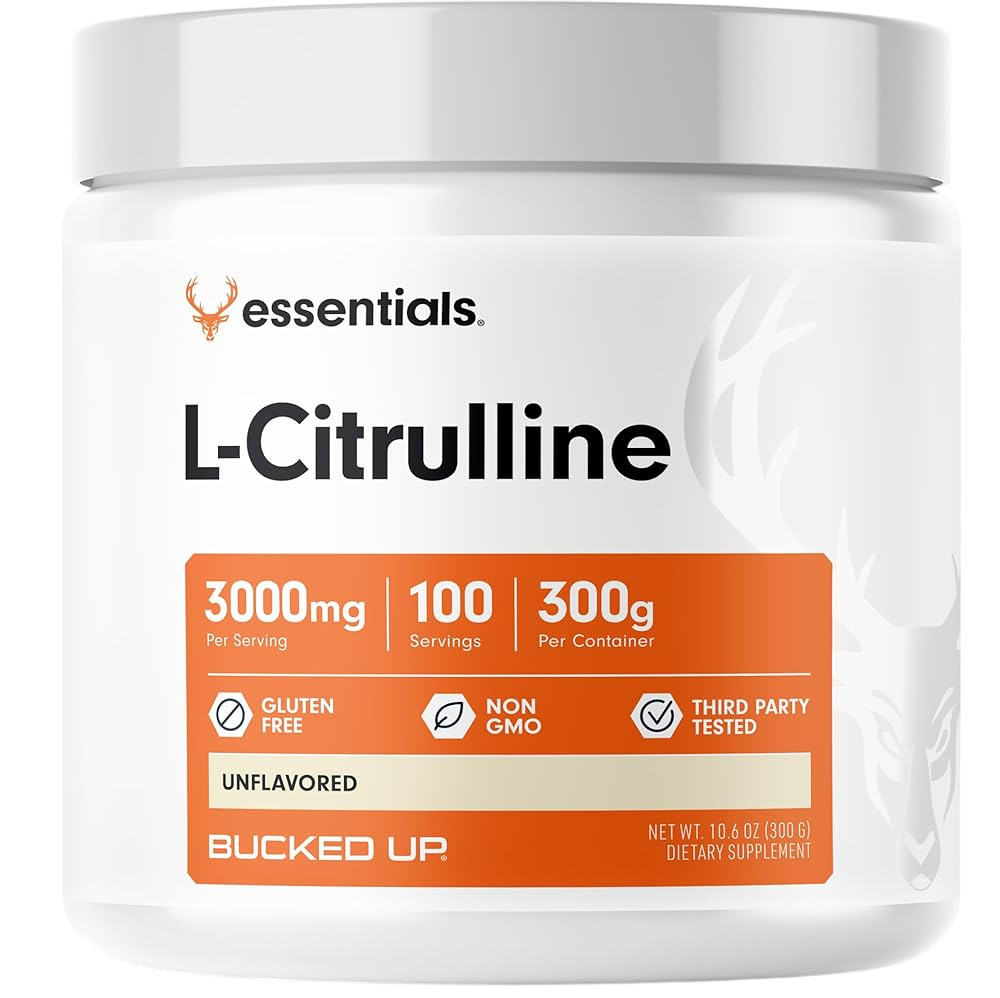
Bucked Up’s L-Citrulline Powder (300 g) provides 3,000 mg of pure L-Citrulline per scoop, with the gram amount clearly listed on the label. No proprietary blends and no dusting. You see the grams on the label, so the dosing math stays transparent.
Timing and Stacking Strategies for L-Citrulline
Timing L-Citrulline correctly helps you feel the most from each scoop. Peak plasma L-Citrulline concentrations occur within 0.7 to 2 hours after ingestion, so taking L-Citrulline about 30–60 minutes before training lines up the conversion window with the start of your workout. This timing works for both Citrulline Malate and pure L-Citrulline.1
Absorption support also matters. Citrulline that is not absorbed is wasted gram-for-gram. Bucked Up includes Astragin® across the pre-workout line, an ingredient studied to support citrulline absorption and bioavailability.*1 Pairing an absorption agent with the citrulline dose helps you get the full benefit of every gram listed on the label.
Advanced stacks can push nitric oxide and pump support even further. The Mother Bucker formula pairs 4 g of pure L-Citrulline with Nitrosigine® (a patented arginine silicate studied for supporting blood flow*) and Hydroprime® Glycerol (studied for supporting cellular hydration and water uptake into muscle cells*).
This combination supports nitric oxide production* and muscle pump* through several biological pathways at once.1 Beta-Alanine, present across the Bucked Up line, supports muscle endurance* by helping buffer lactic acid accumulation during high-intensity training, which complements the blood flow support* from the citrulline matrix.1
Safety and Tolerability: What Research Suggests
L-Citrulline is generally well tolerated at doses studied for performance support and often shows a milder side-effect profile than L-Arginine at similar doses. Consult your healthcare provider before beginning any supplementation protocol, particularly if you take prescription medications or have an existing health condition.
Precautions: Individuals with naturally low blood pressure should talk with a healthcare provider before use, since L-Citrulline’s vasodilatory effects may compound their baseline. Those with kidney conditions should avoid high doses, because impaired renal function affects L-Citrulline metabolism. Discontinue use at least 2 weeks before any scheduled surgery.
L-Citrulline may interact with blood pressure medications, nitrate medications, and phosphodiesterase-5 inhibitors. Always consult your healthcare provider before combining L-Citrulline with any prescription medication. Use during pregnancy or breastfeeding should only occur after consultation with a healthcare provider.
Choosing Transparent L-Citrulline Formulas
Finding a formula that actually delivers the studied dose matters more than memorizing every study. Many pre-workout products can use proprietary blends that list L-Citrulline or Citrulline Malate without disclosing exact amounts. This practice makes it impossible to confirm whether the product reaches the performance threshold.
Bucked Up discloses exact gram amounts across the pre-workout line. Each formula below lists its citrulline dose and form, so you can match the product to your training style and stimulant preference:
-
Bucked Up Pre-Workout: 6,000 mg Citrulline Malate (2:1), 200 mg caffeine, Astragin®. This formula suits athletes who want the studied Citrulline Malate dose with balanced energy support.1
-
Woke AF Pre-Workout: 6,000 mg Citrulline Malate (2:1), 333 mg caffeine, Astragin®. This option supports vasodilation* alongside a higher stimulant load and addresses vasoconstriction concerns that can come with high-caffeine formulas.1
-
Mother Bucker: 4,000 mg pure L-Citrulline, Nitrosigine®, Hydroprime® Glycerol, 400 mg caffeine (split between Caffeine Anhydrous and Microencapsulated Delay Release Caffeine), Astragin®. This advanced stack targets athletes who want multi-pathway nitric oxide and hydration support.*1
-
Non-Stimulant Pre-Workout: 6,000 mg Citrulline Malate (2:1), Astragin®, zero caffeine. This formula supports training performance* for stim-sensitive athletes or evening training sessions.1
All Bucked Up products are manufactured in GMP-certified facilities in the USA, which supports consistent quality and dosing accuracy.
All Bucked Up pre-workouts list exact gram amounts on the label, with no proprietary blends and no guesswork. Compare transparent formulas and build a stack that fits your training.
Evaluating any L-Citrulline formula starts with the label. First, confirm the exact gram amount of Citrulline Malate or pure L-Citrulline per serving, since this shows whether the product can reach the studied performance range.
Next, verify the form (2:1 Citrulline Malate versus pure L-Citrulline), because the ratio determines how much actual citrulline you get per gram of powder. Then check whether an absorption-support ingredient is present, because unabsorbed citrulline cannot deliver benefits even when the label dose looks strong.
Finally, assess whether the total dose aligns with the performance ranges discussed above. Transparent labeling forms the baseline for evidence-based supplementation decisions.
Bucked Up’s L-Citrulline powder delivers 3,000 mg of pure citrulline per scoop, with the dose clearly disclosed on every label.
Frequently Asked Questions
What is the optimal L-citrulline dosage for workout performance?
The resistance-training literature points to a performance threshold of 6–8 g of Citrulline Malate (2:1) or 3–4 g of pure L-Citrulline per serving, taken about 30–60 minutes before training. At 6 g of Citrulline Malate, the formula delivers roughly 3.4 g of actual L-Citrulline plus Malic Acid.
For pure L-Citrulline, 3–4 g reaches a similar or greater citrulline load in fewer total grams because there is no Malic Acid component. Both forms can support nitric oxide production and muscle pump at these doses.1 Doses far below these ranges may not reach the threshold studied for acute performance support.
How much L-citrulline per day is safe?
L-Citrulline is generally well tolerated at 3–8 g per day across studied populations. Mild gastrointestinal discomfort, such as nausea, bloating, or cramps, can appear at very high single doses of 10 g or more. Some sensitive individuals report headaches related to vasodilatory effects at various doses.
There is no universal upper limit established for healthy adults, but single doses above 10 g are associated with a higher incidence of GI side effects and potential arginine over-saturation. Individuals with kidney conditions, low blood pressure, or those taking prescription medications should consult a healthcare provider before using L-Citrulline.
What is the difference between Citrulline Malate and pure L-Citrulline?
Citrulline Malate (2:1) combines L-Citrulline and Malic Acid in a 2:1 ratio by weight. The Malic Acid portion is a Krebs Cycle intermediate studied for its role in supporting aerobic ATP production and phosphocreatine recovery, which may support endurance and reduce fatigue during repeated-effort training. Pure L-Citrulline delivers only the amino acid with no Malic Acid.
Because of this difference, a given gram amount of Citrulline Malate contains less actual citrulline than the same weight of the pure form. Many athletes choose pure L-Citrulline for precise dosing, advanced stacking, or when Malic Acid already appears elsewhere in the formula.
Why does L-Citrulline support nitric oxide production better than L-Arginine?
L-Arginine faces significant degradation by arginase enzymes in the gut and liver during first-pass metabolism, which limits how much reaches systemic circulation after oral supplementation. L-Citrulline bypasses much of this degradation, is absorbed from the small intestine, and is converted into L-Arginine in the kidneys by argininosuccinate synthase and argininosuccinate lyase.
This renal conversion produces a more sustained and substantial increase in plasma L-Arginine compared to direct L-Arginine supplementation. Higher arginine availability provides more substrate for Nitric Oxide Synthase enzymes, which supports nitric oxide production, blood flow, and muscle pump during training.
When should I take L-Citrulline for the best results?
For acute performance support, take L-Citrulline 30–60 minutes before intense physical activity. This pre-workout window, described in the timing section above, helps plasma arginine levels peak as your workout begins, which supports nitric oxide availability when you need it most.
Taking L-Citrulline with an absorption-support ingredient such as Astragin® may further support the bioavailability of each gram consumed. For daily cardiovascular function support in healthy adults, L-Citrulline can be taken in divided doses throughout the day, with the pre-workout serving counting toward the daily total.
References
Trexler, E. T., et al. (2025). L-Citrulline supplementation in sports nutrition: Dosing trends and formulation patterns in pre-workout products. PMC / National Institutes of Health. https://pmc.ncbi.nlm.nih.gov/articles/PMC12918617
1 The content provided in this article is for informational purposes only and is not medical advice. Consult with a medical professional before implementing any changes to your diet, health, or exercise routines. Individual results will vary and are based on a combination of each individual’s diet, exercise, age, and health circumstances. These statements have not been evaluated by the Food and Drug Administration. This product is not intended to diagnose, treat, cure or prevent any disease.
This article was written by Ryan Gardner, CEO of Bucked Up. As the maker of Bucked Up Protein Soda, we have a financial interest in this information. The views expressed are our own and should be read with that context in mind.