Written by: Ryan Gardner, Owner, Managing Partner, CEO, Bucked Up
Key Takeaways on Arginine vs Citrulline
-
L-citrulline bypasses first-pass metabolism in the gut and liver, reaches higher bioavailability, and produces a more sustained rise in plasma arginine than oral L-arginine.1
-
L-arginine is substantially degraded by arginase enzymes before reaching systemic circulation, which limits its effectiveness for nitric oxide production and vasodilation support.*1
-
Studied dosing ranges for exercise outcomes center on 6–8 g of Citrulline Malate 2:1 or 3–6 g of pure L-citrulline taken about 60 minutes before training.1
-
Citrulline Malate 2:1 and pure L-citrulline are not interchangeable gram-for-gram, so label transparency is essential to confirm actual L-citrulline content.
-
Bucked Up’s nitric oxide support strategy uses transparent, disclosed doses of Citrulline Malate and Pure L-Citrulline, with full label visibility on every formula.
How L-Arginine and L-Citrulline Work in Your Body
L-arginine is a conditionally essential amino acid and the direct substrate for nitric oxide synthase (NOS) enzymes, which produce nitric oxide in the body.1 It appears in protein-rich foods such as meat, poultry, fish, and dairy. The body can synthesize L-arginine, yet many pre-workout formulas still include supplemental doses to support blood flow.*
L-citrulline is a non-essential alpha-amino acid named after Citrullus lanatus, the watermelon plant where it was first identified. The intestines and liver produce it naturally, and it also appears in cucumbers, squash, and pumpkins.
Reaching a meaningful supplemental dose from food alone is unrealistic, because roughly 2.2 to 3.3 lbs of watermelon would be needed to deliver just 3 g of L-citrulline. In supplement form, L-citrulline acts as an indirect precursor to L-arginine and follows a more efficient metabolic route that supports nitric oxide production* more reliably than L-arginine itself.1
This comparison matters for exercise performance because nitric oxide supports relaxation of vascular smooth muscle, which supports blood flow and nutrient delivery to working muscles.*1 The amino acid that more consistently raises plasma arginine levels becomes directly relevant for anyone chasing a meaningful pump.*1
Why Nitric Oxide Support Matters for Training*
Nitric oxide is a gaseous signaling molecule produced when NOS enzymes act on L-arginine. It supports relaxation of vascular smooth muscle cells, a process called vasodilation, which supports blood flow and the delivery of oxygen, glucose, and other metabolic substrates to active tissues.*1 When more L-arginine reaches NOS enzymes, nitric oxide output can rise, which supports muscle pump* and nutrient delivery during training.1
L-citrulline also participates in the urea cycle, which converts ammonia, a byproduct of protein metabolism and intense exercise, into urea for excretion. By supporting ammonia clearance,* L-citrulline may help reduce exercise-induced ammonia accumulation in skeletal muscle, which is associated with central fatigue.1
When L-citrulline pairs with malic acid to form Citrulline Malate, the malate component acts as a Krebs Cycle intermediate that may support oxidative ATP production and phosphocreatine recovery, adding an energy-metabolism angle to its vasodilation support.*1
The key technical point is simple. NOS enzymes require L-arginine as a substrate, yet swallowing more L-arginine does not guarantee that more L-arginine reaches those enzymes. The rate-limiting step is how much L-arginine survives the journey from the gut into systemic circulation. Here, the pharmacokinetics of L-citrulline become decisive.
Arginine vs Citrulline for Vasodilation: What the Pharmacokinetics Show
The main pharmacokinetic difference between these amino acids appears in the gap between swallowing a capsule and having usable L-arginine available for nitric oxide synthesis.*
Oral L-arginine is significantly degraded by arginase enzymes in the gut and liver during first-pass metabolism, which limits the amount that reaches systemic circulation (Schwedhelm et al., Br J Clin Pharmacol, 2008).
A 2017 mouse study reported substantial first-pass splanchnic extraction of supplemental L-arginine, while all supplemented L-citrulline appeared in plasma (Agarwal et al., 2017). This pattern is often called the “L-arginine paradox,” because the ingredient that seems like the direct solution is largely neutralized before it can act.
L-citrulline is absorbed through the intestinal wall and bypasses intestinal and liver extraction almost entirely, which gives it high oral bioavailability (Bahri et al., Nutrition, 2013).
It then travels to the kidneys, where argininosuccinate synthase and argininosuccinate lyase convert it into L-arginine, creating a sustained elevation in plasma arginine levels. Peak plasma citrulline and arginine concentrations occur after oral ingestion (Moinard et al., Br J Nutr, 2008).
In the 2008 Schwedhelm et al. randomized human pharmacokinetic study (n=20), oral L-citrulline produced a significantly larger and more sustained rise in plasma arginine exposure than an equivalent oral dose of L-arginine.
A 2015 RCT by Bailey et al. (n=10, J Appl Physiol) found that 6 g/day of pure L-citrulline for 7 days improved exercise tolerance by 12% and total work completed by 7% during severe-intensity cycling compared to placebo, while an equivalent dose of L-arginine did not produce the same outcome.1
These data support the idea that oral L-citrulline supplementation can raise plasma L-arginine levels in a more practical way (Schwedhelm et al., 2008).
Gastrointestinal tolerance creates another real-world difference. Direct L-arginine supplementation can cause significant gastrointestinal distress, including severe cramping and diarrhea, because unabsorbed amino acid draws water into the intestines. L-citrulline is generally well tolerated, and daily doses up to 10 g have shown a favorable safety profile in healthy adults (Allerton et al., Nutrients, 2018).
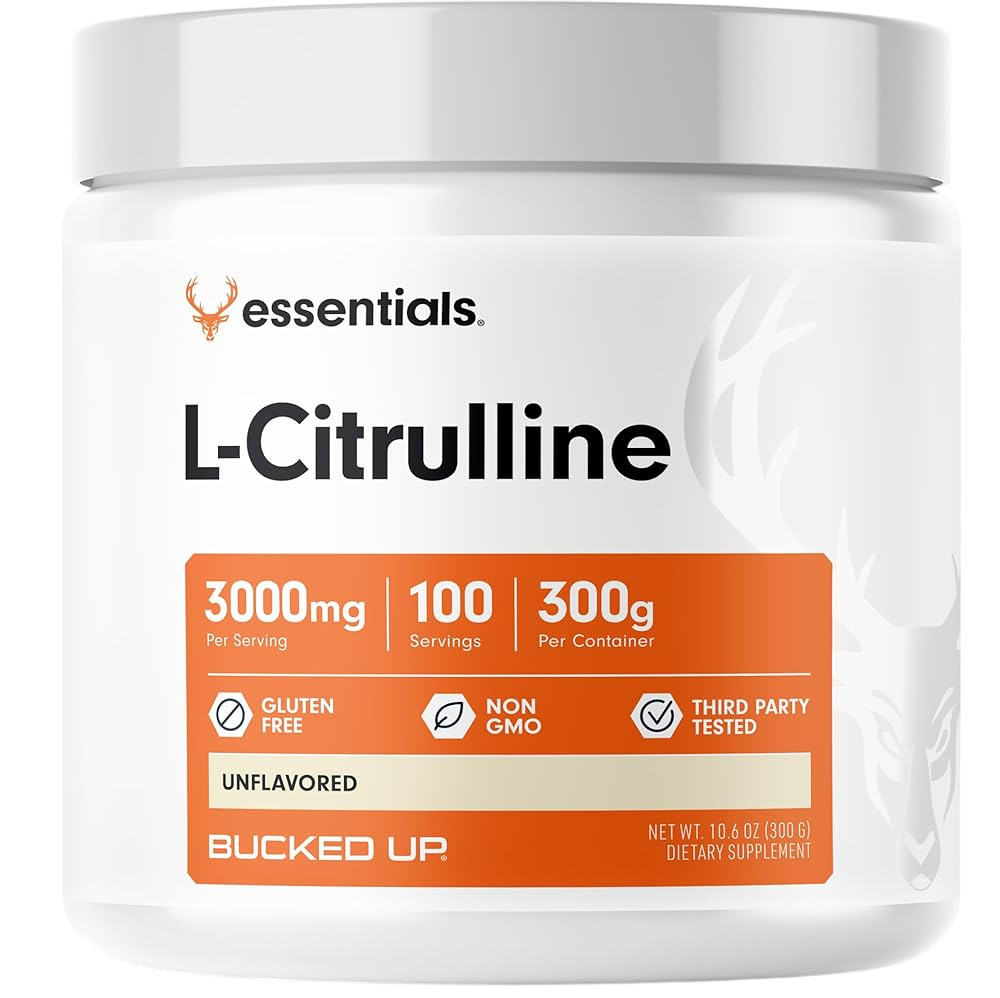
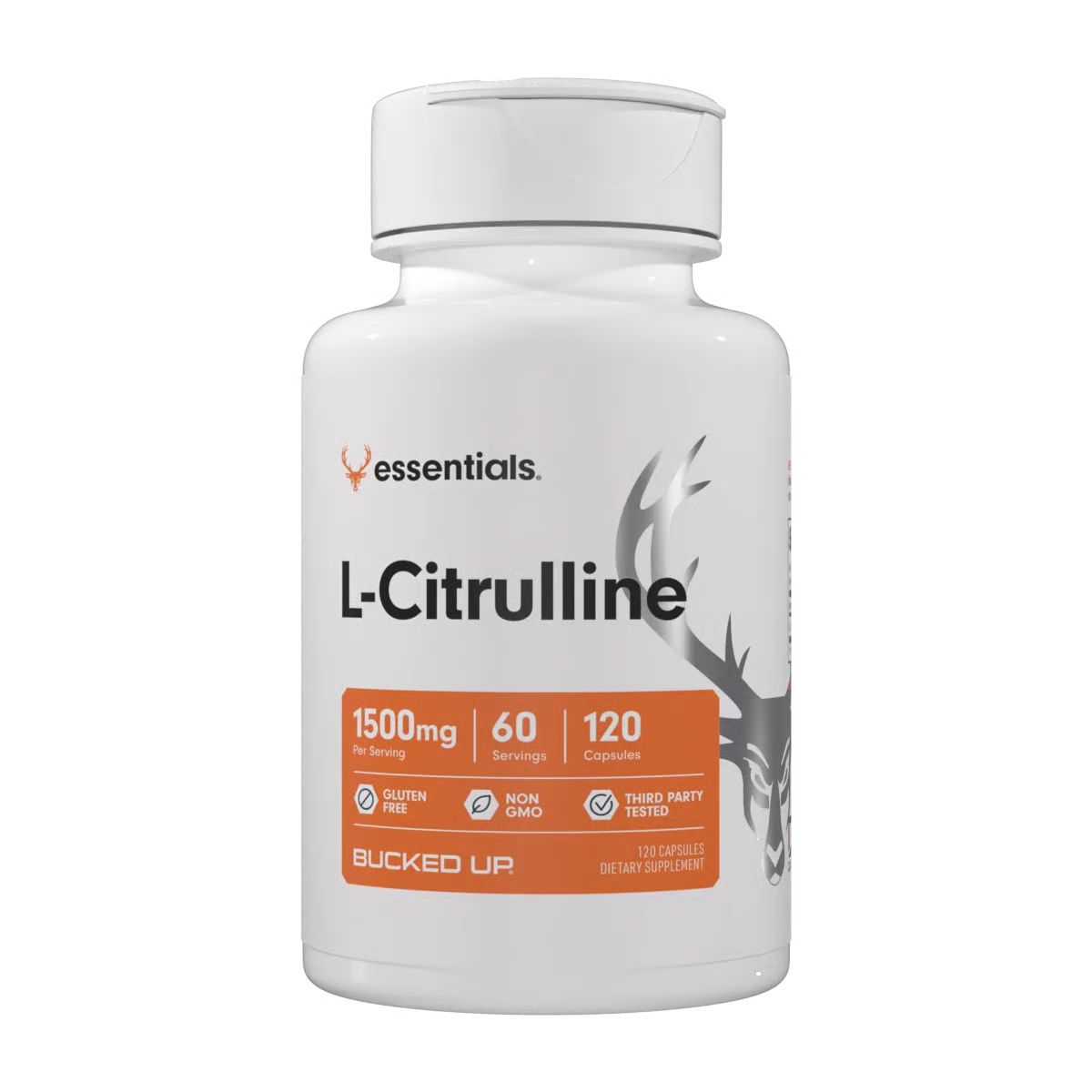
Bucked Up’s approach to nitric oxide support* centers on transparent, disclosed doses of Citrulline Malate and Pure L-Citrulline.1 Explore Bucked Up’s L-Citrulline options with full bioavailability transparency.*
L-Citrulline vs L-Arginine: Dosing and Timing for Muscle Pump Support*
Dosing starts with the form you choose. Citrulline Malate 2:1 is 56.6% L-citrulline by weight, so 6 g of Citrulline Malate 2:1 delivers approximately 3.4 g of actual L-citrulline alongside malic acid. Pure L-citrulline delivers 100% L-citrulline per gram.
A meta-analysis of eight studies reported that 6 to 8 grams of Citrulline Malate taken 40 to 60 minutes before exercise supported repetitions in lower-body resistance exercises compared with placebo.1 For pure L-citrulline, studied dosing ranges for exercise-related outcomes usually fall between 3 and 6 g per day, and multi-day supplementation often produces more consistent results than a single acute dose in trials.
A practical framework can make these numbers easier to use.
Goal: Start by deciding whether you care most about acute pump support,* endurance support,* or both, because that choice guides everything else. If you want both vasodilation and ammonia clearance support,* Citrulline Malate 2:1 covers both pathways.1 If your priority is maximizing nitric oxide precursor availability,* pure L-citrulline stacked with complementary ingredients targets vasodilation through multiple mechanisms.*
Form: Once you have a clear goal, match the form to that goal. Choose Citrulline Malate 2:1 at 6 to 8 g for a dual-action approach, or pure L-citrulline at 3 to 6 g for direct nitric oxide precursor support.* Remember that 6 g of Citrulline Malate 2:1 does not equal 6 g of pure L-citrulline.
Timing: Take L-citrulline about 60 minutes before intense physical activity so the peak plasma concentration window lines up with your training session.
Monitor: Track pump quality,* training endurance,* and recovery across several sessions instead of judging everything from a single workout.
Adjust: Stimulant-sensitive users can choose a non-stimulant pre-workout with Citrulline Malate to separate pump support* from caffeine intake. Athletes with higher tolerance may prefer stacking pure L-citrulline with additional nitric oxide-supporting ingredients.*
Bucked Up’s foundational pre-workouts (Bucked Up and Woke AF) use 6,000 mg of Citrulline Malate 2:1, which sits at the studied threshold for resistance-exercise support.*1
Mother Bucker uses 4,000 mg of pure L-citrulline stacked with Nitrosigine® and Hydroprime® Glycerol for a multi-pathway pump approach.*1 Astragin® appears across the pre-workout line to support citrulline absorption.*1 All doses are disclosed on the label. No proprietary blends.
Common Mistakes When Choosing Between Arginine and Citrulline
Under-dosing. Many pre-workout formulas list L-citrulline on the label but include amounts well below the ranges studied for performance support. Without full label transparency, you cannot tell whether a product contains a meaningful dose or a trace amount used mainly for marketing. Checking the label for the exact gram amount per serving is the only way to evaluate this.
First-pass metabolism confusion. Some people assume that taking more L-arginine will offset its low bioavailability. Current research does not support that idea. L-citrulline maintains a steadier supply of plasma arginine without the rapid spikes and crashes associated with oral L-arginine, because the conversion happens in the kidneys instead of being limited by gut and liver arginase activity.
Citrulline Malate vs pure L-citrulline math. As noted earlier, Citrulline Malate 2:1 and pure L-citrulline are not equivalent gram-for-gram. A label listing “6 g Citrulline Malate” delivers only about 3.4 g of actual L-citrulline. Comparing products means checking both the form and the gram amount to understand how much L-citrulline you actually get per serving.
Digestive tolerance. High single doses of L-arginine often correlate with gastrointestinal distress. L-citrulline usually has a more favorable tolerance profile, yet doses above 10 g in a single sitting can still cause nausea or bloating for some people.
Starting within studied ranges and assessing tolerance before increasing the dose is a reasonable approach. Consult your healthcare provider before use if you have underlying health conditions or take prescription medications.
Bucked Up discloses every gram of Citrulline Malate and Pure L-Citrulline on the label, with no proprietary blends and no guessing. See the exact gram amounts in Bucked Up’s L-Citrulline lineup.*
Frequently Asked Questions About Arginine and Citrulline
Why does L-citrulline raise plasma arginine levels more effectively than L-arginine itself?
L-arginine is broken down by arginase enzymes in the gut and liver during first-pass metabolism, so a substantial portion of an oral dose never reaches systemic circulation.
L-citrulline is not a substrate for arginase, so it passes through the intestinal wall largely intact, enters the bloodstream, and is converted to L-arginine in the kidneys. This renal conversion produces a slower, more sustained elevation in plasma arginine compared to the rapid but short-lived spike from oral L-arginine supplementation.
What is the difference between Citrulline Malate and pure L-citrulline?
Citrulline Malate is a compound of L-citrulline and malic acid, typically in a 2:1 ratio. Because it is 56.6% L-citrulline by weight, 6 g of Citrulline Malate 2:1 delivers approximately 3.4 g of actual L-citrulline. The malic acid component is a Krebs Cycle intermediate theorized to support oxidative ATP production and phosphocreatine recovery, which adds an energy-metabolism dimension alongside nitric oxide support.*
Pure L-citrulline delivers 100% L-citrulline per gram and often appears in advanced stacking protocols where the goal is maximizing the nitric oxide precursor dose* without the malic acid component.
How long before a workout should I take L-citrulline?
Peak plasma concentrations of L-citrulline and the resulting L-arginine elevation occur in the hours after oral ingestion. Taking L-citrulline 45 to 60 minutes before training aligns supplementation with this pharmacokinetic window. For multi-day supplementation protocols, consistent daily dosing at any time of day can build sustained plasma arginine levels over time.
Is L-citrulline safe, and are there any interactions to consider?
L-citrulline is generally well tolerated at studied doses and usually has a more favorable gastrointestinal profile than L-arginine. Daily doses up to 10 g have been used in research without significant adverse effects in healthy adults.
Because L-citrulline supports vasodilation,* individuals taking blood pressure medications, nitrate medications, or phosphodiesterase-5 inhibitors should consult their healthcare provider before use, since additive vasodilatory effects are possible. Individuals who are pregnant, breastfeeding, or have kidney conditions should also consult their healthcare provider before supplementing with L-citrulline.
What does Astragin® do in a pre-workout formula containing L-citrulline?
Astragin® is a patented ingredient studied to support the absorption and bioavailability of amino acids, including L-citrulline.*1 Including it in a pre-workout formula means that the L-citrulline on the label has additional support for being absorbed and utilized, rather than passing through the digestive system without contributing to plasma arginine elevation. Bucked Up includes Astragin® across its pre-workout line for this reason.
Key Takeaways on Using Arginine vs Citrulline for Vasodilation
The evidence reviewed here confirms what the pharmacokinetics predict: oral L-citrulline is usually the more effective route for elevating plasma arginine to support nitric oxide production* and muscle pump.*1 L-arginine often faces significant degradation by arginase in the gut and liver before it reaches systemic circulation, which limits its usefulness as a direct supplement for vasodilation support.*
Apply the dosing ranges covered earlier, using 6 to 8 g of Citrulline Malate 2:1 or 3 to 6 g of pure L-citrulline, timed about 60 minutes before training. Form matters, because Citrulline Malate 2:1 and pure L-citrulline are not interchangeable on a gram-for-gram basis.
Bucked Up’s approach to L-citrulline is built on full label transparency. The foundational pre-workouts use 6,000 mg of Citrulline Malate 2:1 for dual vasodilation and ammonia clearance support.* Mother Bucker stacks 4,000 mg of pure L-citrulline with Nitrosigine® and Hydroprime® Glycerol for a multi-pathway pump approach.* Astragin® appears across the line to support citrulline absorption.* Every gram is on the label. No proprietary blends. No dusting.
Bucked Up’s L-citrulline formulas deliver the studied doses covered here, with full transparency on every label. Browse Bucked Up’s fully disclosed L-Citrulline formulas—no proprietary blends.*
*These statements have not been evaluated by the Food and Drug Administration. This product is not intended to diagnose, treat, cure, or prevent any disease.
References
Schwedhelm, E., Maas, R., Freese, R., Jung, D., Lukacs, Z., Jambrecina, A., Spickler, W., Schulze, F., & Böger, R. H. (2008). Pharmacokinetic and pharmacodynamic properties of oral L-citrulline and L-arginine: Impact on nitric oxide metabolism. British Journal of Clinical Pharmacology, 65(1), 51–59. https://doi.org/10.1111/j.1365-2125.2007.02990.x
Bailey, S. J., Blackwell, J. R., Lord, T., Vanhatalo, A., Winyard, P. G., & Jones, A. M. (2015). L-citrulline supplementation improves O2 uptake kinetics and high-intensity exercise performance in humans. Journal of Applied Physiology, 119(4), 385–395. https://doi.org/10.1152/japplphysiol.00192.2014
1 The content provided in this article is for informational purposes only and is not medical advice. Consult with a medical professional before implementing any changes to your diet, health, or exercise routines. Individual results will vary and are based on a combination of each individual’s diet, exercise, age, and health circumstances. These statements have not been evaluated by the Food and Drug Administration. This product is not intended to diagnose, treat, cure or prevent any disease.
This article was written by Ryan Gardner, CEO of Bucked Up. As the maker of Bucked Up Protein Soda, we have a financial interest in this information. The views expressed are our own and should be read with that context in mind.