Written by: Ryan Gardner, Owner, Managing Partner, CEO, Bucked Up | Last updated: June 15, 2026
Key Takeaways
-
Serious athletes typically target 6–8 g of citrulline malate or 3–4 g of pure L-citrulline per serving to match research-backed performance doses.
-
Always convert labeled amounts to active citrulline content, because citrulline malate 2:1 usually delivers only a portion of its weight as L-citrulline.
-
Third-party certifications such as NSF Certified for Sport, Informed Sport, or BSCG Certified Drug Free help protect athletes who face drug testing.
-
Cost comparisons become more accurate when you look at price per gram of active citrulline instead of headline serving size.
-
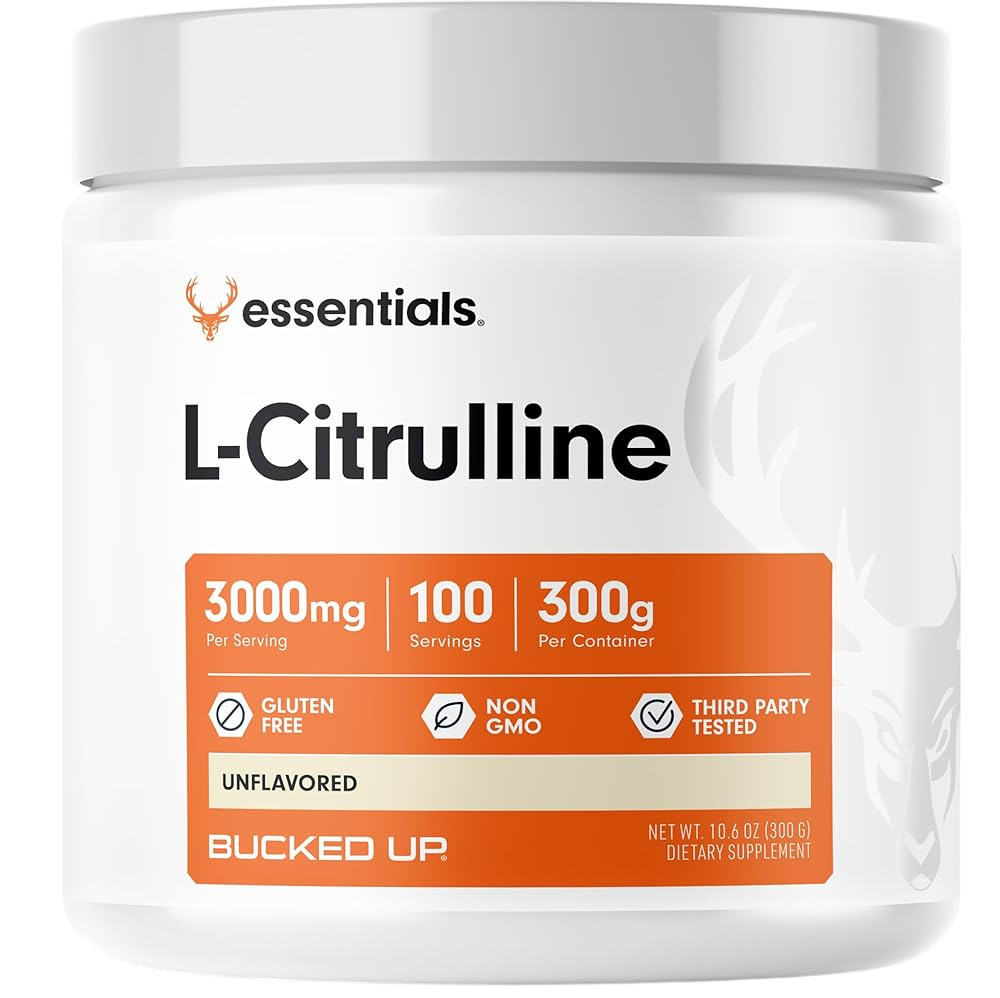
Bucked Up’s standalone L-Citrulline powder gives athletes a transparent, third-party-tested option for dialing in exact doses and building custom stacks.
Evidence for Effective L-Citrulline Dosing
The 6 to 8 g range is the starting point for any serious evaluation of L-citrulline products. A meta-analysis of eight studies found that 6 to 8 g of citrulline malate taken 40 to 60 minutes before exercise supported repetitions in lower-body resistance exercises compared with placebo.1 That range serves as the reference point throughout this article.
Two primary mechanisms explain why dose matters at this level.
-
Nitric oxide support.* L-citrulline bypasses first-pass metabolism in the gut and liver, is converted to L-arginine in the kidneys, and raises plasma L-arginine concentrations, providing substrate for nitric oxide synthase enzymes. Higher and more sustained plasma L-arginine supports nitric oxide production,* which in turn supports vasodilation.*1
-
Ammonia clearance.* L-citrulline is an intermediate in the urea cycle, the pathway that converts ammonia, a byproduct of intense exercise and protein metabolism, into urea for excretion. Supporting ammonia clearance* at performance doses may reduce exercise-induced fatigue accumulation in skeletal muscle.1
Peak plasma concentrations of L-citrulline typically occur within 0.7 to 2 hours after ingestion, which informs the 45 to 60-minute pre-exercise timing window used in most performance studies. Sub-threshold doses between 1 and 3 g appear on many pre-workout labels but sit below the range studied for acute performance support. Evaluating a product starts with confirming that the labeled dose sits at or above 6 g for citrulline malate, or at or above 3 to 4 g for pure L-citrulline at equivalent active citrulline content.
Comparing Pure L-Citrulline and Citrulline Malate 2:1
The form on the label determines how much active citrulline a serving actually delivers. The two most common forms in performance supplements are pure L-citrulline and citrulline malate, and they do not match on a gram-for-gram basis.
-
Active citrulline content by weight. Citrulline malate 2:1 (the standard commercial form) is approximately 72% citrulline by weight, so 1 g delivers roughly 720 mg citrulline. Pure L-citrulline delivers approximately 1,000 mg of citrulline per gram. A label listing 6 g of citrulline malate 2:1 provides roughly 3.4 g of active L-citrulline.
-
Performance-dose equivalence. To match a 4 g pure L-citrulline dose using citrulline malate 2:1, a product typically needs to list about 7 to 8 g of citrulline malate. Gram-for-gram comparisons between pure L-citrulline and citrulline malate should be based on active citrulline content rather than total blend weight to keep dosing equivalent.
-
Malate’s role in energy metabolism. Malic acid is a Krebs cycle intermediate with a theoretical role in supporting oxidative ATP production and lactate clearance. However, a systematic review (Gough et al., Eur J Appl Physiol, 2021) concluded that adding malate to citrulline has not been shown to enhance exercise performance or provide an ergogenic advantage over pure L-citrulline at equivalent citrulline doses.
-
Label accuracy risk. Some independent testing of commercial citrulline malate products has revealed variability in actual citrulline-to-malate ratios, which means they may contain less citrulline by weight than expected. A product claiming 6 g of citrulline malate 2:1 may deliver less active citrulline if the ratio differs from the label.
The practical takeaway is simple. Convert the labeled dose to active citrulline content before comparing products, and verify the stated ratio against third-party testing when that information is available.
Third-Party Testing and Drug-Tested Athletes
Manufacturing under Good Manufacturing Practice (GMP) standards sets a baseline for quality control, but GMP alone does not include banned-substance screening. Competitive athletes who face drug testing need certifications that go further.
-
NSF Certified for Sport: Tests for more than 270 substances banned by major sports organizations and verifies label claims for ingredient identity and quantity.
-
Informed Sport: Provides lot-by-lot testing for banned substances and is recognized by WADA-aligned anti-doping programs.
-
BSCG Certified Drug Free: BSCG screens every lot for more than 450 drugs and verifies GMP compliance and label accuracy.
The stakes for skipping this step are significant. Evaluations by Sport Integrity Australia found that more than 35% of 200 uncertified sports supplements contained undeclared banned substances. Sports drug-testing authorities apply strict liability, which means athletes are responsible for any substance detected during testing regardless of its source. Selecting products with documented third-party certification offers a direct way to reduce that risk. Athletes competing under drug-testing programs should confirm current certification status directly with the brand before use.
How to Compare L-Citrulline Brands
Clear criteria make it easier to evaluate any L-citrulline supplement at performance-focused doses.
-
Dose disclosure: The label should list the exact milligrams of L-citrulline or citrulline malate per serving, with no proprietary blend hiding the amount.
-
Form and ratio transparency: The label should specify pure L-citrulline or citrulline malate, and for citrulline malate it should state the ratio, such as 2:1.
-
Active citrulline at performance doses: A serving should deliver at least 3 to 4 g of active L-citrulline, which corresponds to 6 to 8 g of citrulline malate 2:1.
-
Third-party testing documentation: The brand should show verifiable GMP certification and either provide or pursue third-party banned-substance testing.
-
Cost per gram of active citrulline: The real cost should be normalized to active citrulline content at a 6 to 8 g performance dose.
Bucked Up’s formulas appear here as examples that meet these criteria. The foundational pre-workouts, Bucked Up and Woke AF, each list 6,000 mg of citrulline malate 2:1 on the label, which delivers approximately 3.4 g of active L-citrulline per serving. Mother Bucker lists 4,000 mg of pure L-citrulline alongside Nitrosigine® and Hydroprime® Glycerol, with Astragin® included across the line to support citrulline absorption.*1 Standalone pure L-citrulline powder is also available for athletes who prefer custom stacking protocols.
Cost-per-Serving at Performance Doses
Cost comparisons between L-citrulline products become meaningful only when normalized to active citrulline content. A simple calculation keeps the comparison fair.
-
Identify the price per serving from the product label or retailer listing.
-
Determine the active citrulline per serving. Pure L-citrulline delivers 100% of the stated weight, while citrulline malate 2:1 delivers the active citrulline proportion discussed earlier, and independent testing has found actual ratios as low as 52% in some commercial products.
-
Divide price per serving by grams of active citrulline to get cost per gram of active citrulline.
-
Multiply by the target dose, such as 3 to 4 g for pure L-citrulline or 6 to 8 g for citrulline malate, to get cost per performance dose.
Consider a quick example. A product listing 8 g of citrulline malate 2:1 at $1.50 per serving delivers about 5.3 g of active citrulline, for a cost of roughly $0.28 per gram of active citrulline. A pure L-citrulline product at $1.20 per serving that delivers 4 g provides active citrulline at $0.30 per gram. The option with the lower headline gram count can still offer equivalent or better value once active content enters the calculation. Cost-per-effective-dose calculations for L-citrulline products should account for the citrulline malate ratio to reveal the true active ingredient cost at performance doses.
Daily L-Citrulline Protocols and Timing
For acute performance support, athletes typically take L-citrulline about 60 minutes before intense physical activity to match peak plasma concentration windows. For citrulline malate formulas, the 45 to 60-minute window aligns with timing used in many performance studies.
Athletes who do not train every day can use a consistent morning dose to support baseline plasma L-arginine levels, then add a pre-training dose on workout days. If maintaining steady plasma levels is the priority, splitting a larger daily dose, such as 6 g total, into two servings may support more consistent levels across the day. Athletes using Bucked Up’s standalone pure L-citrulline powder can dial in exact doses for stacking and adjust timing independently of a full pre-workout formula. Always consult your healthcare provider before beginning any new supplementation protocol, especially if you have existing health conditions or take prescription medications.
Smart Stacking Options with L-Citrulline
L-citrulline pairs well with several performance ingredients that support complementary mechanisms.
-
Nitrosigine® (inositol-stabilized arginine silicate): Supports nitric oxide production* through a distinct arginine-based pathway, which makes it a logical stack with L-citrulline for athletes targeting blood flow support.*1 Mother Bucker combines 4 g of pure L-citrulline with Nitrosigine® for this reason.
-
Hydroprime® Glycerol: Supports cellular hydration and fluid uptake into muscle tissue,* which complements the vasodilatory mechanisms of L-citrulline.1 Hydroprime® appears in Mother Bucker’s “Pump Trifecta.”
-
Beta-alanine: Supports muscle endurance* by buffering lactic acid accumulation and addresses a fatigue pathway distinct from ammonia clearance.1 Beta-alanine is present in all Bucked Up pre-workout formulas.
-
Astragin®: Appears across the Bucked Up pre-workout line to support citrulline absorption.*1 Athletes using standalone citrulline powder can stack Astragin® separately.
-
Creatine monohydrate: Supports phosphocreatine resynthesis,* which may complement the Krebs cycle support theorized for the malate component of citrulline malate.1
Frequently Asked Questions
What is the difference between pure L-citrulline and citrulline malate 2:1?
Pure L-citrulline delivers approximately 1,000 mg of active citrulline per gram of product. Citrulline malate 2:1 combines L-citrulline and malic acid in a 2:1 ratio by weight, which reduces the amount of citrulline per gram compared with the pure form, as outlined in the conversion details above. To reach an equivalent active citrulline dose, you need more total grams of citrulline malate 2:1 than pure L-citrulline. The malate component is a Krebs cycle intermediate theorized to support energy metabolism, though current systematic review evidence has not confirmed that malate adds ergogenic benefit over pure L-citrulline at equivalent active citrulline doses.
How much L-citrulline should a serious athlete take per serving?
Performance-focused research has used 6 to 8 g of citrulline malate, which provides roughly 3.4 to 4.5 g of active L-citrulline, as a pre-exercise dose taken 45 to 60 minutes before training. For pure L-citrulline, the equivalent active dose usually falls between 3 and 4 g per serving. Daily use for general support has been studied at 3 to 6 g of pure L-citrulline per day. Always consult your healthcare provider to determine the appropriate dose for your individual circumstances.
Why does the citrulline-to-malate ratio matter on a supplement label?
Independent testing of commercial citrulline malate products has found actual ratios ranging from 1.11:1 to 1.92:1 instead of the labeled 2:1, which means some products deliver as little as 52% active citrulline by weight. A product claiming 6 g of citrulline malate 2:1 could deliver anywhere from about 3.1 g to 4 g of active citrulline depending on the actual ratio. Confirming the stated ratio and cross-referencing with third-party testing data offers the most reliable way to verify what a serving actually delivers.
What should competitive athletes look for in terms of testing and certification?
GMP certification addresses manufacturing quality but does not include banned-substance screening. Competitive athletes subject to drug testing should prioritize products with NSF Certified for Sport, Informed Sport, or BSCG Certified Drug Free certification, because these programs conduct lot-by-lot screening for banned substances and verify label accuracy. Strict liability rules in most drug-testing programs mean athletes bear responsibility for any detected substance regardless of source, so third-party certification documentation becomes a meaningful risk-reduction step.
Can L-citrulline be taken daily, or only on training days?
L-citrulline is generally well-tolerated at performance doses and has been studied in both acute single pre-exercise doses and daily supplementation protocols. Daily use may support more consistent plasma L-arginine levels over time. Gastrointestinal discomfort, including nausea or bloating, has been reported at very high single doses of 10 g or more but appears less common at the 3 to 6 g range used in many performance protocols. Individuals with kidney conditions, low blood pressure, or those taking blood pressure medications or nitrate medications should consult their healthcare provider before use, because L-citrulline’s vasodilatory effects may interact with these conditions or medications.
References
Gough, L. A., Sparks, S. A., McNaughton, L. R., Higgins, M. F., Newbury, J. W., Trexler, E., Faghy, M. A., & Bridge, C. A. (2021). A critical review of citrulline malate supplementation and exercise performance. European Journal of Applied Physiology, 121(12), 3283–3295.
Chappell, A. J., Allwood, D. M., & Simper, T. N. (2018). Citrulline malate supplementation does not improve German Volume Training performance or reduce muscle soreness in moderately trained males and females. Journal of the International Society of Sports Nutrition, 15(1), 42.
BSCG. (2024). Pre-workout supplement powder facts, ingredients, and safety. https://bscg.org/blogs/single/pre-workout-supplement-powder-facts-ingredients-safety
Verywell Health. (2024). Citrulline: Benefits, uses, and side effects. https://verywellhealth.com/citrulline-4774848
1 The content provided in this article is for informational purposes only and is not medical advice. Consult with a medical professional before implementing any changes to your diet, health, or exercise routines. Individual results will vary and are based on a combination of each individual’s diet, exercise, age, and health circumstances. These statements have not been evaluated by the Food and Drug Administration. This product is not intended to diagnose, treat, cure or prevent any disease.
This article was written by Ryan Gardner, CEO of Bucked Up. As the maker of Bucked Up Protein Soda, we have a financial interest in this information. The views expressed are our own and should be read with that context in mind.