Written by: Ryan Gardner, Owner, Managing Partner, CEO, Bucked Up
Key Takeaways
-
Clinical dosing of L-Citrulline means looking for 3g to 8g of pure L-Citrulline or 6g to 8g of Citrulline Malate 2:1 per serving, not trace amounts hidden in proprietary blends.
-
Citrulline Malate 2:1 delivers roughly 57% L-Citrulline by weight, so 6,000mg of the 2:1 form provides about 3,400mg of actual L-Citrulline, while pure L-Citrulline delivers 100% of the listed amount.
-
L-Citrulline converts to L-Arginine in the kidneys to support nitric oxide production and blood flow, bypassing the first-pass metabolism that limits direct L-Arginine supplementation.
-
Absorption-support ingredients like Astragin® and complementary compounds such as Nitrosigine® or Hydroprime® Glycerol can enhance the effectiveness of L-Citrulline in advanced formulas.
-
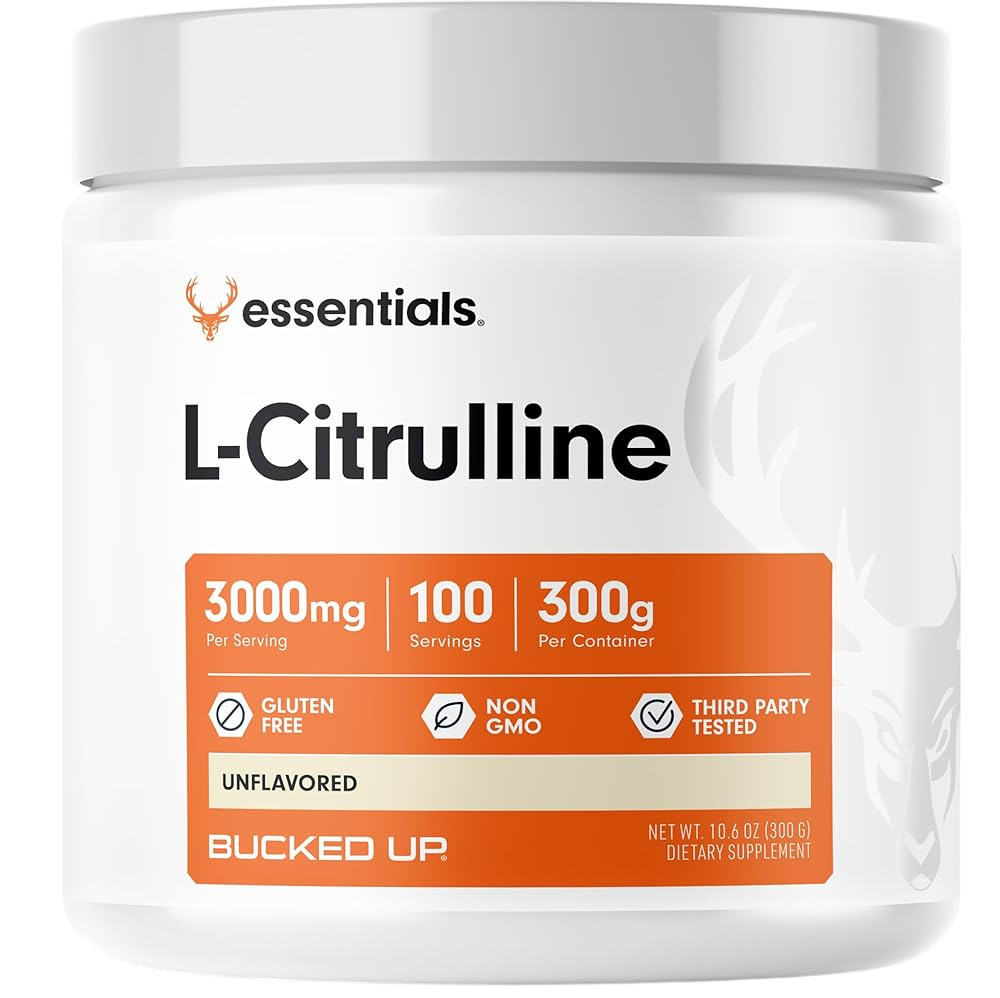
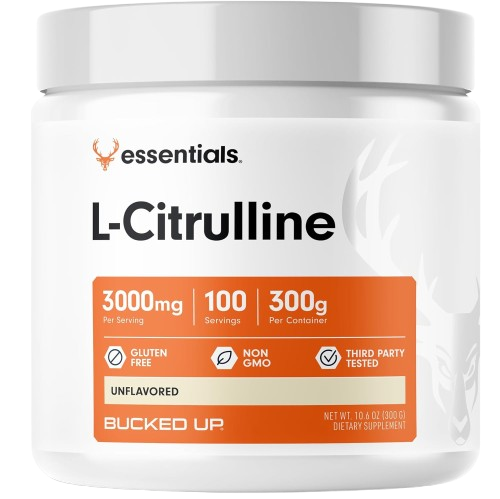
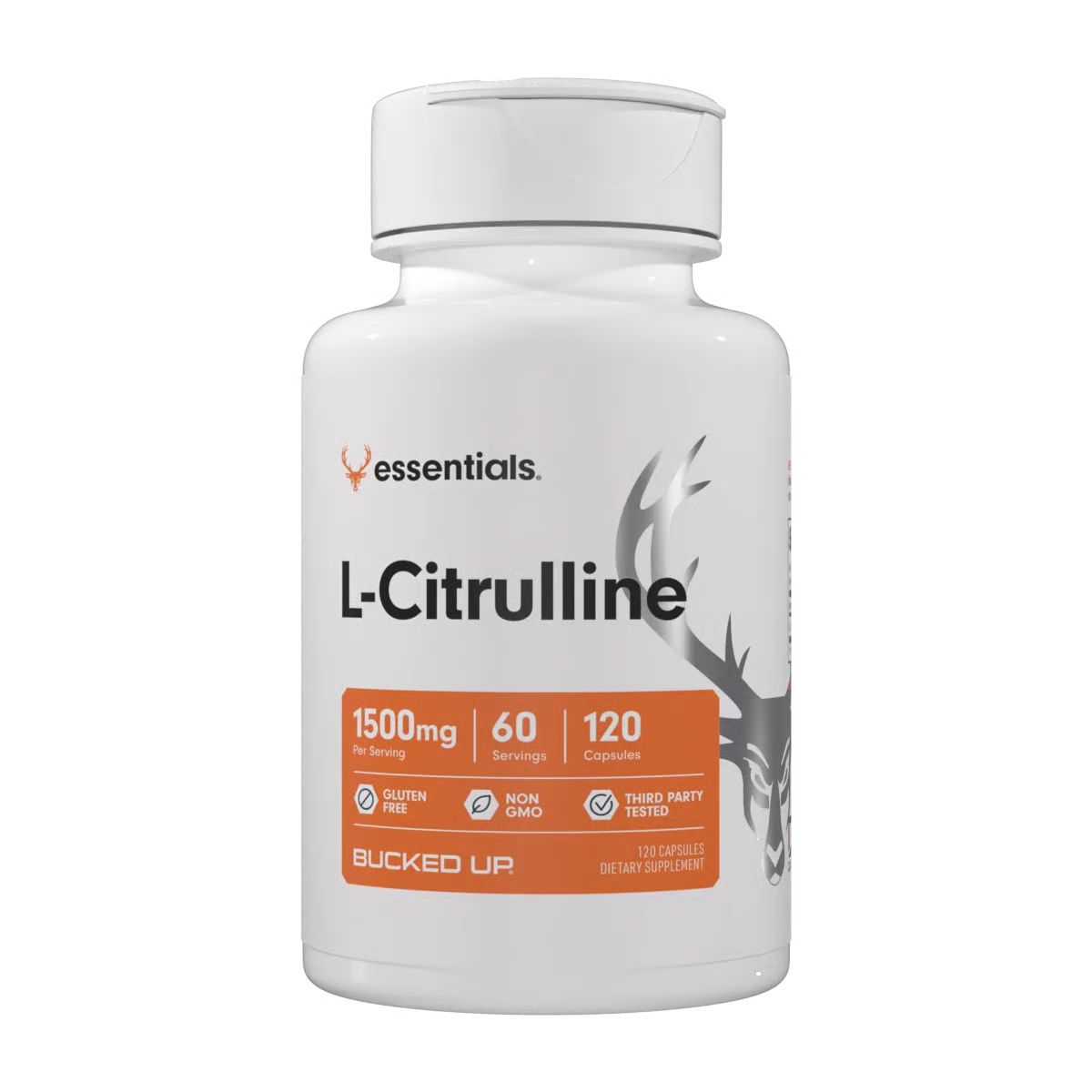
Bucked Up offers science-backed L-Citrulline options with disclosed doses; shop Bucked Up’s transparently labeled L-Citrulline products.
How L-Citrulline Works in Effective Serving Ranges
L-Citrulline is a non-essential amino acid that converts to L-Arginine in the kidneys. L-Citrulline supports nitric oxide production by being converted to L-Arginine in the kidneys, allowing L-Arginine to serve as the direct substrate for nitric oxide synthase (NOS) to generate nitric oxide.1 This conversion pathway avoids the arginase-mediated breakdown that limits direct L-Arginine supplementation and supports more sustained plasma L-Arginine availability.1
For resistance and high-intensity training, researched servings for pure L-Citrulline typically fall between 3g and 8g. Citrulline Malate is often studied at 6g to 8g per serving taken approximately 60 minutes before exercise. These are the numbers worth looking for on a label. Anything substantially below that range, particularly when hidden inside a proprietary blend, is worth scrutinizing before purchase. This is where transparent labeling becomes a practical decision factor rather than a marketing claim.
Bucked Up promotes a science-backed approach to dosing, including Citrulline Malate and pure L-Citrulline at disclosed amounts. See the full ingredient disclosure for Bucked Up’s L-Citrulline products.
Citrulline Malate 2:1 Versus Pure L-Citrulline: Conversion in Real Numbers
Label reading becomes more precise once you understand how Citrulline Malate 2:1 is structured. Citrulline Malate 2:1 is a compound of L-Citrulline and Malic Acid in a two-to-one ratio by weight. Every 1.76g of Citrulline Malate 2:1 delivers approximately 1g of actual L-Citrulline, with the remaining weight coming from Malic Acid. A label listing 6,000mg of Citrulline Malate 2:1 is delivering roughly 3,400mg of pure L-Citrulline alongside approximately 2,000mg of Malic Acid.
This profile is not a flaw in the formula. Malic Acid is a Krebs Cycle intermediate studied for its role in supporting aerobic ATP production and supporting ammonia clearance during exercise. The Citrulline supports nitric oxide production and blood flow*, and the Malic Acid supports the energy side of the equation.1 The 2:1 form appears in foundational resistance training research, including studies using 8g of Citrulline Malate that reported support for total repetitions performed across multiple sets.
Pure L-Citrulline, by contrast, delivers 100% L-Citrulline per gram listed. A formula using 4,000mg of pure L-Citrulline is delivering 4,000mg of the active compound directly, without the Malic Acid component. This form is often chosen when a formula already includes other energy-pathway ingredients or when the goal is to stack L-Citrulline with additional nitric oxide support ingredients like Nitrosigine®.
The practical takeaway is straightforward. When comparing two pre-workouts, check which form is listed and apply the conversion before drawing conclusions about which delivers more L-Citrulline per serving.
Absorption, Astragin®, and Complementary Pump Ingredients
L-Citrulline already has a favorable absorption profile. L-Citrulline exhibits approximately 97% oral bioavailability and is efficiently absorbed in the small intestine via amino acid transporters, reaching systemic circulation largely intact without significant hepatic first-pass metabolism.1
Given that baseline, some formulas still include absorption-support ingredients. The idea is that even small improvements in the uptake of a 6g or 8g serving can increase the amount of active compound reaching its target pathway. Bucked Up includes Astragin® across its pre-workout line, an ingredient studied to support citrulline absorption and bioavailability.*1 The approach is simple: disclose the dose on the label, then support the body’s ability to use it.
Some advanced formulas also stack L-Citrulline with Nitrosigine®, a patented form of bonded arginine silicate, and Hydroprime® Glycerol, which supports cellular hydration and water uptake into muscle tissue.* This combination targets nitric oxide production and muscle fullness through multiple pathways at the same time, rather than relying on a single mechanism.1
Timing, Stacking, and Everyday Use Patterns
Peak plasma concentrations of L-Citrulline typically occur within 0.7 to 2 hours post-ingestion, as reported in pharmacokinetic research. This timing explains why a 60-minute pre-workout window works for most training schedules and aligns with common research protocols.
For daily use outside of training, researched serving ranges for pure L-Citrulline run from 3g to 6g per day, sometimes divided into two servings. Daily use supports goals that extend beyond a single workout, while acute pre-workout dosing focuses on performance during a specific training session.
Stacking is common in this category. L-Citrulline pairs naturally with Beta-Alanine for endurance support*, with caffeine for energy, and with nootropic ingredients like Alpha GPC for focus. The key stacking consideration is whether the formula discloses every ingredient amount individually, so the user can evaluate the full picture rather than guessing at what a proprietary blend contains.
Bucked Up promotes a science-backed approach to dosing, including Citrulline Malate and pure L-Citrulline. Explore Bucked Up’s L-Citrulline options with disclosed stacking ingredients.
Who Usually Looks for Clinical L-Citrulline Doses
A search for a pre workout with clinical dose of L citrulline usually comes from people who already train regularly and care about the science behind what they take. They have moved past buying whatever is on sale and now read labels, compare forms, and ask why a formula is built a certain way.
Common profiles in this category include lifters who feel “flat” during training despite using pre-workouts. Other common profiles include athletes who want to understand the difference between pump ingredients and stimulant ingredients, and experienced users who have developed tolerance to high-caffeine formulas and want to dial in the non-stimulant side of their stack.
Anyone with existing health conditions, those who are pregnant or breastfeeding, individuals on prescription medications including blood pressure medications or nitrate medications, or anyone scheduled for surgery should consult a healthcare provider before using L-Citrulline supplements. This is not a formality. L-Citrulline’s vasodilatory effects can interact with certain medications in ways that require professional guidance.
How to Evaluate Pre-Workouts with L-Citrulline
When evaluating any pre-workout in this category, the following criteria are worth applying systematically rather than relying on marketing language alone. These checkpoints help separate formulas that can match researched serving ranges from those that rely on underdosed ingredients or vague labeling.
Ingredient form disclosed: Check whether the label specifies Citrulline Malate 2:1 or pure L-Citrulline. A label that lists only “Citrulline” without specifying the form makes it impossible to calculate actual L-Citrulline delivered per serving.
Serving size listed openly: Look for the gram amount for L-Citrulline or Citrulline Malate listed as an individual figure, not grouped inside a proprietary blend with other ingredients. Individual disclosure allows direct comparison across products.
Conversion math applied: After identifying the form, apply the conversion to determine actual L-Citrulline content. For example, 6,000mg of Citrulline Malate 2:1 delivers approximately 3,400mg of L-Citrulline, while 4,000mg of pure L-Citrulline delivers the full 4,000mg. The pure form in this example provides more actual L-Citrulline despite the lower total weight on the label, which makes the conversion step essential for accurate product comparison.
Supporting ingredients present: Note whether the formula includes absorption-support ingredients like Astragin®. Also note whether it includes complementary nitric oxide support like Nitrosigine® and cellular hydration support like Hydroprime® Glycerol. These additions matter most when comparing formulas at similar L-Citrulline amounts.
Caffeine level and tolerance match: Pre-workouts in this category can range from stimulant-free options with 6,000mg Citrulline Malate to high-stimulant formulas with 400mg caffeine. The right caffeine level depends on individual tolerance and training schedule, not on which number is largest.
Flavor and mixability: A pre-workout that tastes unpleasant or clumps in the shaker is more likely to be skipped on hard training days. Flavor quality and powder solubility are practical factors that affect consistency of use.
Frequently Asked Questions
Should L-Citrulline be taken every day or only on training days?
Both patterns appear in the research literature. For acute training performance support, taking L-Citrulline approximately 60 minutes before exercise is a standard protocol. For general daily use, some research uses divided daily servings regardless of training schedule. The appropriate pattern depends on the goal. A pre-workout formula is typically designed for training-day use, while a standalone L-Citrulline powder or capsule product offers more flexibility for daily dosing protocols.
What is the practical difference between Citrulline Malate 2:1 and pure L-Citrulline?
Citrulline Malate 2:1 delivers L-Citrulline alongside Malic Acid, a Krebs Cycle intermediate that supports aerobic energy production and ammonia clearance. Pure L-Citrulline delivers only the amino acid, with no Malic Acid component. Neither form is universally superior. Citrulline Malate is the form used in much of the resistance training research. Pure L-Citrulline is often chosen when a formula already includes other energy-pathway ingredients or when stacking with additional nitric oxide support compounds. The key is applying the conversion math to understand how much L-Citrulline each form delivers per gram listed on the label.
When should someone consult a healthcare provider before using L-Citrulline?
Anyone taking prescription medications, particularly blood pressure medications, nitrate medications, or PDE5 inhibitors, should consult a healthcare provider before adding L-Citrulline to their routine. The same guidance applies to individuals with kidney conditions, those who are pregnant or breastfeeding, and anyone scheduled for surgery within two weeks. L-Citrulline’s vasodilatory effects are well-documented, and those effects can interact with certain medications or health conditions in ways that require professional evaluation.
How do I know if a pre-workout is actually dosed at researched amounts?
Start by checking the supplement facts panel for individual ingredient amounts rather than a grouped proprietary blend total. Identify whether the formula uses Citrulline Malate 2:1 or pure L-Citrulline, then apply the conversion to calculate actual L-Citrulline delivered. Compare that number against the serving ranges used in the research literature for the training goal you are targeting. If the label does not disclose individual amounts, verifying the dose is not possible.
Conclusion: Reading Labels and Setting Realistic Expectations
The search for a pre workout with clinical dose of L citrulline comes down to three things. You need to know the researched serving ranges, understand the conversion math between Citrulline Malate 2:1 and pure L-Citrulline, and read labels with enough specificity to verify what is actually in the serving. A formula that discloses every ingredient amount individually, uses a recognized form of L-Citrulline at a serving size aligned with the research literature, and includes absorption support is a formula worth evaluating seriously.
L-Citrulline supports nitric oxide production, blood flow, muscle pump, and training endurance.*1 Those effects are documented in the literature and remain dose-dependent. A label that lists L-Citrulline without specifying the form or the amount does not provide the information needed for a meaningful evaluation. Transparent labeling functions as a baseline requirement for assessing whether a product can align with what the research supports.
Bucked Up promotes a science-backed approach to dosing, including Citrulline Malate and pure L-Citrulline at disclosed amounts across the pre-workout line. Shop Bucked Up’s transparently labeled L-Citrulline products.
*These statements have not been evaluated by the Food and Drug Administration. This product is not intended to diagnose, treat, cure, or prevent any disease.
References
Bahri, S., et al. (2013). Intestinal absorption of L-citrulline. Nutrition. https://pmc.ncbi.nlm.nih.gov/articles/PMC5833233/
1 The content provided in this article is for informational purposes only and is not medical advice. Consult with a medical professional before implementing any changes to your diet, health, or exercise routines. Individual results will vary and are based on a combination of each individual’s diet, exercise, age, and health circumstances. These statements have not been evaluated by the Food and Drug Administration. This product is not intended to diagnose, treat, cure or prevent any disease.
This article was written by Ryan Gardner, CEO of Bucked Up. As the maker of Bucked Up Protein Soda, we have a financial interest in this information. The views expressed are our own and should be read with that context in mind.