Written by: Ryan Gardner, Owner, Managing Partner, CEO, Bucked Up
Key Takeaways
-
L-Citrulline raises plasma arginine levels more effectively than oral L-Arginine because it bypasses intestinal and liver breakdown.1
-
After absorption, L-Citrulline converts to L-Arginine in the kidneys and supports higher, more sustained arginine levels for nitric oxide production.
-
Performance studies report that L-Citrulline and Citrulline Malate can improve resistance training repetitions and endurance when taken at 6 to 8 g, 30 to 60 minutes pre-workout.1
-
Stacking oral L-Arginine with L-Citrulline does not meaningfully extend nitric oxide support because oral L-Arginine has poor bioavailability.
-
Bucked Up provides L-Citrulline options formulated to support consistent workout performance.
How L-Arginine and L-Citrulline Support Bodybuilding
The urea cycle clears ammonia from the body, and L-Citrulline sits at the center of that process. During hard training, protein metabolism produces ammonia as a byproduct. L-Citrulline helps move that ammonia toward urea for excretion, which may help reduce exercise-related fatigue.1 L-Arginine plays a different role as the direct substrate for nitric oxide synthase (NOS) enzymes. These enzymes produce nitric oxide, a signaling molecule that relaxes vascular smooth muscle and supports vasodilation. Wider blood vessels support the delivery of oxygen, glucose, and other nutrients to working muscle.1
Pharmacokinetics create a clear separation between these two amino acids. Oral L-Arginine is substantially degraded by arginase enzymes in the gut and liver before it reaches systemic circulation. L-Citrulline is not a substrate for arginase, so it is absorbed intact, travels to the kidneys, and converts to L-Arginine through the sequential action of argininosuccinate synthetase and argininosuccinate lyase. This conversion pathway explains why L-Citrulline supplementation can raise plasma L-Arginine levels more effectively than taking L-Arginine directly.1
One conversion note worth keeping on your label-reading radar: 1.76 g of Citrulline Malate (2:1) provides approximately 1 g of pure L-Citrulline, meaning a 6 g dose of Citrulline Malate delivers roughly 4 g of actual L-Citrulline. That ratio matters when you compare labels.
Stacking L-Arginine and L-Citrulline for Workout Performance
Given L-Citrulline’s stronger bioavailability and conversion to L-Arginine, many lifters wonder whether stacking both offers extra benefits. The bioavailability data suggests that stacking provides little additional support for nitric oxide. Because L-Citrulline converts to L-Arginine in the kidneys, adding oral L-Arginine on top does not meaningfully extend the nitric oxide pathway. The bottleneck is not total arginine intake. The limiting factor is how much arginine survives first-pass metabolism and reaches systemic circulation. L-Citrulline sidesteps that bottleneck.
L-Citrulline has a substantially more favorable pharmacokinetic profile than oral L-Arginine. Stacking both is unlikely to be harmful for healthy adults, yet current performance data points to L-Citrulline as the more efficient way to sustain plasma arginine and downstream nitric oxide production. Consult your healthcare provider before combining amino acid supplements, especially if you take medications or manage health conditions.
Workout Performance: Arginine vs Citrulline in Real Training
Resistance training research leans toward L-Citrulline and Citrulline Malate. Studies using 8 g of Citrulline Malate have reported significant increases in total repetitions to muscular failure across multiple sets compared to placebo.1 Citrulline Malate has also been studied for support of lower-body weight training performance and recovery from delayed onset muscle soreness.
Endurance data tells a similar story. In a 2015 study by Bailey et al. in the Journal of Applied Physiology, L-Citrulline supplementation improved exercise tolerance and total work completed during severe-intensity cycling.1 L-Arginine at the same dose did not produce these performance benefits, even though both supplements raised plasma arginine levels. That head-to-head comparison highlights the practical impact of L-Citrulline’s pharmacokinetic advantage.
A 2022 meta-analysis (PubMed, PMID 35345719) and a 2021 systematic review (PubMed, PMID 34747788) further support the ergogenic potential of L-Citrulline across resistance and aerobic training. Evidence for L-Arginine producing similar outcomes at comparable oral doses remains limited.
Bucked Up promotes a science-focused approach to nitric oxide support with fully disclosed ingredient amounts. Explore Bucked Up formulas that feature clinically studied amounts of Citrulline Malate and Pure L-Citrulline for performance-focused training.
L-Citrulline and Citrulline Malate Dosing for Workouts
The 6 to 8 g range used in many performance studies on Citrulline Malate represents the most consistently examined dosing protocol. These studies typically administer the dose 30 to 60 minutes before exercise. For pure L-Citrulline, research in healthy adults has examined daily doses of 3 to 6 g for nitric oxide and cardiovascular support.
Timing plays a key role. Taking L-Citrulline 30 to 60 minutes before training aligns with the window used in most performance trials. Dosing too close to your workout may mean plasma levels have not yet peaked when you start lifting or cardio.
L-Citrulline is generally well tolerated at doses used in research. Some people experience gastrointestinal discomfort, such as nausea or bloating, at very high single doses.1 Individuals with low blood pressure, kidney conditions, or those taking blood pressure medications, nitrate medications, or phosphodiesterase-5 inhibitors should talk with a healthcare provider before use. Pregnant or breastfeeding individuals should also consult a healthcare provider before supplementing.
Citrulline Malate vs Pure L-Citrulline in Pre-Workouts
Citrulline Malate combines L-Citrulline with malic acid, a Krebs Cycle intermediate involved in aerobic ATP production. The malate component is theorized to support oxidative energy metabolism and phosphocreatine recovery alongside vasodilation. Pure L-Citrulline delivers 100% L-Citrulline per gram, so it offers a more concentrated option when you want direct nitric oxide support.
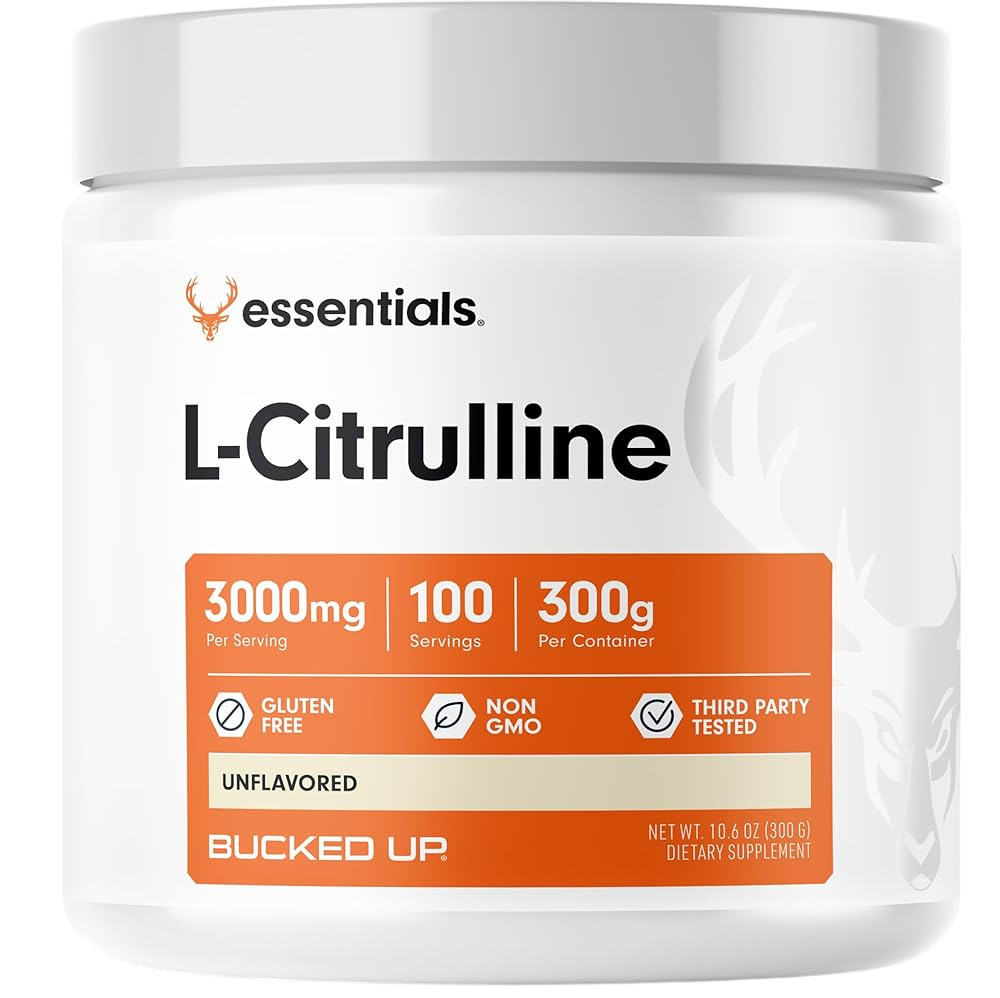
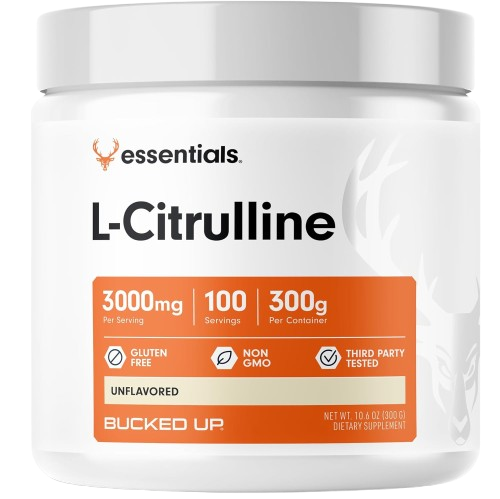
Bucked Up’s foundational pre-workouts, including Bucked Up Pre-Workout and Woke AF, provide 6,000 mg of Citrulline Malate (2:1), which aligns with the range most studied for resistance training support. Mother Bucker increases total pump support by using 4,000 mg of Pure L-Citrulline alongside Nitrosigine® and Hydroprime® Glycerol, creating a broader nitric oxide and hydration stack. Every formula in the Bucked Up line includes Astragin®, which has been studied for its potential to support citrulline absorption and bioavailability.1 For athletes who want standalone dosing flexibility, Bucked Up L-Citrulline Powder (300 g) supplies 3,000 mg of Pure L-Citrulline per scoop with no additional active ingredients. This structure makes it simple to adjust your dose or stack with any pre-workout.
Reading Pre-Workout Labels for Citrulline Transparency
Clear label reading helps you match what you buy to what the research supports. Start by checking whether citrulline grams are fully disclosed or hidden inside a proprietary blend. A proprietary blend lists a total weight for a group of ingredients without listing individual amounts. That structure makes it impossible to confirm whether any single ingredient reaches the studied range for performance.
Specific checkpoints on any pre-workout label include the exact gram amount of citrulline per serving, the form used, and any absorption-support ingredients. Confirm whether the product uses Citrulline Malate (2:1) or Pure L-Citrulline, then apply the conversion math discussed earlier. Look for an ingredient such as Astragin® with a disclosed amount. Bucked Up lists every ingredient gram amount on the label across its pre-workout line, so the citrulline dose is always visible.
Conclusion: Practical Criteria for Choosing L-Arginine or L-Citrulline
The pharmacokinetic advantage of L-Citrulline over oral L-Arginine centers on first-pass metabolism. L-Arginine is substantially degraded before it reaches systemic circulation. L-Citrulline bypasses that degradation, converts to L-Arginine in the kidneys, and supports more sustained plasma arginine levels and nitric oxide production. Performance data from resistance and endurance studies supports L-Citrulline and Citrulline Malate at 6 to 8 g taken 30 to 60 minutes pre-workout. Stacking oral L-Arginine on top of L-Citrulline is not strongly supported by current bioavailability evidence as a meaningful upgrade.
When you evaluate labels, focus on fully disclosed gram amounts, the citrulline form and ratio, and any ingredients that support absorption. Always consult your healthcare provider before starting a new supplement protocol. Ready to apply these criteria in practice? Compare Bucked Up’s fully disclosed L-Citrulline formulas and see how the citrulline dose and form line up with the research.
Frequently Asked Questions
Is L-Citrulline or L-Arginine better for supporting nitric oxide production during workouts?
L-Citrulline generally provides more efficient support for nitric oxide production during workouts. L-Citrulline bypasses the first-pass degradation that limits oral L-Arginine’s bioavailability, which results in more sustained plasma arginine elevation and better substrate availability for nitric oxide synthase enzymes.
What is the difference between Citrulline Malate and Pure L-Citrulline, and which should I use?
Citrulline Malate combines L-Citrulline with malic acid, usually in a 2:1 ratio. The malic acid component is a Krebs Cycle intermediate theorized to support aerobic energy metabolism alongside nitric oxide pathways. Pure L-Citrulline delivers only L-Citrulline, so each gram contributes directly to arginine and nitric oxide support. Given the 2:1 conversion ratio discussed earlier, a 6 g serving of Citrulline Malate provides less pure L-Citrulline than 6 g of the pure form. Citrulline Malate is widely studied for resistance training and endurance support. Pure L-Citrulline often fits high-dose stacking protocols or combinations with other nitric oxide ingredients like Nitrosigine®. Consult your healthcare provider if you are unsure which form fits your goals.
Do I need to take both L-Arginine and L-Citrulline together?
Current evidence does not strongly support stacking oral L-Arginine with L-Citrulline as a key strategy for nitric oxide support. Because L-Citrulline converts to L-Arginine in the kidneys and bypasses first-pass degradation, adding oral L-Arginine does not fix the underlying bioavailability limitation. Performance research that compares the two directly, including a 2015 study by Bailey et al., found that L-Citrulline improved exercise tolerance while L-Arginine at the same dose did not, despite similar plasma arginine increases. L-Citrulline alone, at an appropriate dose, remains the more studied approach for workout performance support.
How much L-Citrulline should I take before a workout, and when should I take it?
Research on muscular endurance and resistance training performance most often uses 6 to 8 g of Citrulline Malate or equivalent doses of Pure L-Citrulline taken about 30 to 60 minutes before exercise. Timing your dose 45 to 60 minutes pre-workout aligns with the window used in many performance studies. For Pure L-Citrulline, daily doses of 3 to 6 g have been examined for nitric oxide support in healthy adults. Always consult your healthcare provider before starting a new supplement protocol, especially if you have health conditions or take medications.
What should I look for on a pre-workout label to verify the citrulline dose is adequate?
Look for a clearly listed gram amount for citrulline on the supplement facts panel, not just a mention inside a proprietary blend total. Confirm whether the form is Citrulline Malate (2:1) or Pure L-Citrulline, since the conversion math differs between them. A serving of Citrulline Malate at the same gram weight as Pure L-Citrulline will provide less actual L-Citrulline because of the malate component. Check for any absorption-support ingredients and verify that their amounts are also disclosed. Proprietary blends that list citrulline without a gram amount prevent you from confirming whether the dose matches ranges studied for performance.
References
Bailey, S. J., et al. (2015). L-citrulline supplementation improves O2 uptake kinetics and high-intensity exercise performance in humans. Journal of Applied Physiology. https://pubmed.ncbi.nlm.nih.gov/25781395
Schwedhelm, E., et al. (2008). Pharmacokinetic and pharmacodynamic properties of oral L-citrulline and L-arginine: impact on nitric oxide metabolism. British Journal of Clinical Pharmacology. https://pubmed.ncbi.nlm.nih.gov/19034643
Pérez-Guisado, J., & Jakeman, P. M. (2010). Citrulline malate enhances athletic anaerobic performance and relieves muscle soreness. Journal of Strength and Conditioning Research. https://pmc.ncbi.nlm.nih.gov/articles/PMC5295087
Gough, L. A., et al. (2021). A critical review of citrulline malate supplementation and exercise performance. European Journal of Sport Science. https://pubmed.ncbi.nlm.nih.gov/34747788
Viribay, A., et al. (2022). Effects of citrulline supplementation on exercise performance in humans. Nutrients. https://pubmed.ncbi.nlm.nih.gov/35345719
Moinard, C., et al. (2022). Citrulline dosing and timing for muscular endurance support. PMC. https://ncbi.nlm.nih.gov/pmc/articles/PMC9529960
1 The content provided in this article is for informational purposes only and is not medical advice. Consult with a medical professional before implementing any changes to your diet, health, or exercise routines. Individual results will vary and are based on a combination of each individual’s diet, exercise, age, and health circumstances. These statements have not been evaluated by the Food and Drug Administration. This product is not intended to diagnose, treat, cure or prevent any disease.
This article was written by Ryan Gardner, CEO of Bucked Up. As the maker of Bucked Up Protein Soda, we have a financial interest in this information. The views expressed are our own and should be read with that context in mind.