Last updated: April 22, 2026
Key Takeaways
- L-Citrulline reduces muscle fatigue by clearing ammonia through the urea cycle and boosting nitric oxide for blood flow and nutrient delivery.1
- Studies report that 8 g Citrulline Malate can increase reps by up to 53% and cut soreness by about 40% across resistance and endurance training.1
- Effective workout dosing typically ranges from 6–8 g Citrulline Malate or 3–6 g pure L-Citrulline, taken 30–60 minutes before training.1
- Citrulline Malate (2:1) pairs L-Citrulline with malic acid for energy support, while pure L-Citrulline focuses on nitric oxide; match the form to your goals.1
- Bucked Up includes research-aligned L-Citrulline doses plus absorption support like Astragin®; shop Bucked Up L-Citrulline.1
How L-Citrulline Targets Workout Fatigue
L-Citrulline attacks muscle fatigue through two primary mechanisms that address the root causes of mid-set failure: ammonia clearance and nitric oxide production. These pathways work together to help you push for more reps and recover faster between sets.1
L-Citrulline, Ammonia, and Lactic Acid Buildup
L-citrulline plays a central role in the body’s urea cycle, which accelerates ammonia clearance and reduces lactic acid buildup during hard efforts. Faster removal of these metabolic byproducts delays muscular exhaustion and supports more efficient mitochondrial ATP production.1
L-Citrulline and Nitric Oxide for Blood Flow
L-citrulline also acts as a highly bioavailable precursor in the citrulline–NO cycle, converting to L-arginine in the kidneys and sustaining nitric oxide production. Higher nitric oxide levels support better blood flow, oxygen delivery, and nutrient transport to working muscles.1
| Study | Dose | Outcome | Source |
|---|---|---|---|
| Pérez-Guisado 2010 | 8 g CM | Up to +53% reps; ~40% less DOMS | PubMed |
| Glenn 2017 | 8 g CM | More total work (leg press and bench) | J Dietary Supplements |
| Suzuki 2016 | L-Cit | About 1.5% faster cycling time | PubMed |
| Bailey 2015 | 6 g L-Cit | Improved oxygen kinetics during high-intensity work | J Appl Physiol |
Beyond these individual studies, a comprehensive systematic review and meta-analysis of 8 randomized controlled trials published in Frontiers in Nutrition (2025) found that L-citrulline supplementation improved flow-mediated dilation by a weighted mean difference of 1.81%.
Taken together, the research shows that L-Citrulline can support more repetitions, lower perceived fatigue, and faster recovery between sets by easing the physiological bottlenecks that limit performance.1
Dialing In L-Citrulline Dose, Timing, and Form
Effective L-Citrulline use depends on matching dose and timing to your training style and choosing the form that fits your goals.
Citrulline Malate vs L-Citrulline: Which Fits Your Training?
Performance Lab recommends 6–8 g per day of pure L-citrulline or about 8 g per day of citrulline malate (2:1 ratio) before training for pump and performance.1 The difference comes from composition. In a 2:1 citrulline malate product, a 6 g serving typically provides about 4 g L-citrulline and 2 g malate.
How Long L-Citrulline Takes to Start Working
Citrulline malate is often taken around one hour before exercise to support muscle recovery and endurance.1 Performance Lab notes that L-citrulline reaches peak levels about 30–60 minutes pre-workout, and daily use can help during high-volume phases.
| Form | Dose | Best For | Timing |
|---|---|---|---|
| Citrulline Malate 2:1 | 6–8 g | Resistance and endurance sessions | About 60 min pre |
| Pure L-Citrulline | 3–6 g | Daily use and nitric oxide support | 30–60 min pre |
When you compare L-Citrulline products, look for clear labels that list exact ingredient amounts and include absorption support to help your body use what you take.
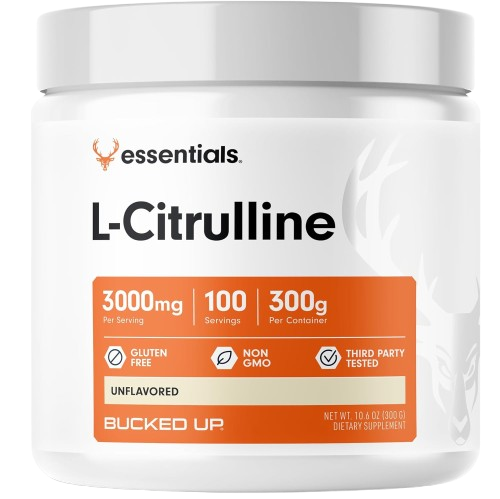
Bucked Up L-Citrulline Formulas for Fatigue and Pump
Bucked Up focuses on transparent dosing and recognizable ingredients in its L-Citrulline formulas. Some competitors can use proprietary blends that hide exact amounts, while Bucked Up lists 6 g and higher doses that line up with research protocols. View Bucked Up Pre-Workout label.
The Bucked Up Pre-Workout provides 6,000 mg of Citrulline Malate (2:1 ratio) plus Astragin® for absorption support. This dose sits comfortably within the effective range seen in performance studies. The formula supports pump and endurance through L-Citrulline for nitric oxide and malic acid for energy metabolism.1
Woke AF keeps the same 6,000 mg Citrulline Malate dose for performance support and pairs it with 333 mg caffeine for users who prefer higher stimulants.1 View Woke AF label.
Mother Bucker includes 4,000 mg pure L-Citrulline with Nitrosigine® and Hydroprime® Glycerol to support muscle fullness and nutrient delivery.1 View Mother Bucker label.
The inclusion of Astragin® across Bucked Up pre-workouts supports consistent bioavailability of key ingredients.1
Troubleshooting L-Citrulline Non-Responders
Some lifters feel little from L-Citrulline at first, often because of dose, timing, or absorption. Products that provide at least 6 g Citrulline Malate, which yields about 4 g L-Citrulline, sit closer to research-backed ranges than formulas that only supply 2–3 g.1
Timing plays a major role as well. L-citrulline absorbs well on an empty stomach and supports nitric oxide production, but it still needs 30–60 minutes to reach peak plasma levels before training.
Beginners often do well with the standard Bucked Up Pre-Workout, which includes 6 g Citrulline Malate and a moderate caffeine level. Stimulant-sensitive users can choose the Non-Stimulant Pre-Workout, which keeps the same Citrulline Malate dose without caffeine. Advanced users who want a stronger pump focus can look at Mother Bucker’s multi-pathway formula. View labels.
Astragin® may help users with digestive sensitivities or heavy supplement stacks by supporting nutrient absorption.
L-Citrulline Safety and Common Questions
Research reports no adverse events with oral L-Citrulline doses up to 15 grams in healthy adults, with less gastrointestinal distress than L-Arginine.1
Mild gastrointestinal discomfort can appear with very high single doses above 10 g, although this tends to be uncommon at typical pre-workout levels.1 More relevant for most users is L-Citrulline’s vasodilatory effect, which widens blood vessels and can lower blood pressure slightly. People with already low blood pressure, or those taking antihypertensive medications or PDE5 inhibitors, should talk with a healthcare provider before using L-Citrulline.
*These statements have not been evaluated by the Food and Drug Administration. This product is not intended to diagnose, treat, cure, or prevent any disease.
Putting It Together: Using L-Citrulline to Push More Reps
Current research supports L-Citrulline at appropriate doses as a way to reduce muscle fatigue, increase reps to failure, and support recovery between sessions.1 Products that feature clear dosing, recognizable ingredients, and absorption support make it easier to line up your intake with what studies actually use. Bucked Up formulations provide research-aligned Citrulline amounts to support workout performance.
Frequently Asked Questions
Does L-Citrulline reduce fatigue?
Yes. As detailed in the research section above, L-Citrulline reduces fatigue through ammonia detoxification and enhanced nitric oxide production, with studies showing up to 53% more repetitions at effective doses.1
What is a good L-Citrulline dosage for beginners?
Beginners can start with 6 g Citrulline Malate taken about 60 minutes before exercise. This serving provides roughly 4 g pure L-Citrulline, which falls within the effective range seen in studies.1 Starting here lets you gauge tolerance while still using a meaningful dose, and you can take it daily during regular training phases.
Citrulline Malate vs pure L-Citrulline: how should I choose?
Both forms support performance, but they emphasize slightly different benefits. Citrulline Malate pairs L-Citrulline with malic acid, which supports the Krebs cycle for energy production and may help buffer lactic acid.1 Pure L-Citrulline delivers only the active amino acid for focused nitric oxide support. Many athletes use Citrulline Malate for endurance and resistance work, while pure L-Citrulline is popular for pump and vascularity. Your training style and personal response should guide the choice.
Are there any side effects from L-Citrulline?
L-Citrulline generally shows a strong safety profile at recommended doses. Rare gastrointestinal discomfort can occur with very high single doses above 10 g, but typical pre-workout servings sit below that level. Unlike L-Arginine, L-Citrulline usually causes less digestive distress.1 Individuals with naturally low blood pressure, or those on blood pressure medications, should consult a healthcare provider because of L-Citrulline’s vasodilatory effects.
How long does L-Citrulline take to kick in?
L-Citrulline usually reaches peak plasma concentrations within 30–60 minutes after ingestion. As noted in the dosing guidelines above, this window aligns well with pre-workout use, and many users choose the 60-minute mark to reliably match peak levels with the start of training. Effects on nitric oxide and ammonia handling begin in this period and can carry through the workout, especially with consistent daily use.1
1 The content provided in this article is for informational purposes only and is not medical advice. Consult with a medical professional before implementing any changes to your diet, health, or exercise routines.
Individual results will vary and are based on a combination of each individual’s diet, exercise, age, and health circumstances.
These statements have not been evaluated by the Food and Drug Administration. This product is not intended to diagnose, treat, cure or prevent any disease.
This article was written by Ryan Gardner, CEO of Bucked Up. As the maker of Bucked Up Protein Soda, we have a financial interest in this information. The views expressed are our own and should be read with that context in mind.